The Front-End customer experience that makes MSPs look like Rockstars
You’re an MSP. You work behind the scenes—quietly solving problems, securing systems, deploying solutions, and keeping your clients productive and protected. You make things run, often without fanfare.
But from the customer’s perspective? Much of that value remains unseen.
When your work is invisible, confusion can creep in. Customers aren’t always clear on what they’re paying for, what they could be buying, or how much you’re actually doing. This lack of visibility can make it harder to retain clients, grow accounts, or create upsell opportunities.
So, what if you could flip that script?
What if your customers could see your value—clearly and instantly? What if they could explore your services, understand your offerings, and even buy from you with the same ease they expect from other digital providers?
That’s the power of a Digital Commerce Platform (DCP) for MSPs.
In this article, we’ll explore why the front-end experience is becoming essential for MSPs, how it complements your backend systems, and how ZaveIT helps you bring it all together.
The invisibility challenge
As an MSP, you manage security, software, endpoints, networks—you keep everything ticking. But when your Customer asks: “What do you actually do?” — what’s the answer?
- Are you just a necessity, like an insurance premium that must be paid but is rarely seen?
- Are you an investment, delivering ROI, and empowering their team?
- Or are you a strategic partner, shaping their business growth? Many MSPs fall into the first category by default—especially for smaller customers. Engagement becomes reactive rather than proactive.
Do I really need a digital commerce front-end? Isn’t my PSA enough?
To understand the answer, it helps to look back at how MSPs got here.
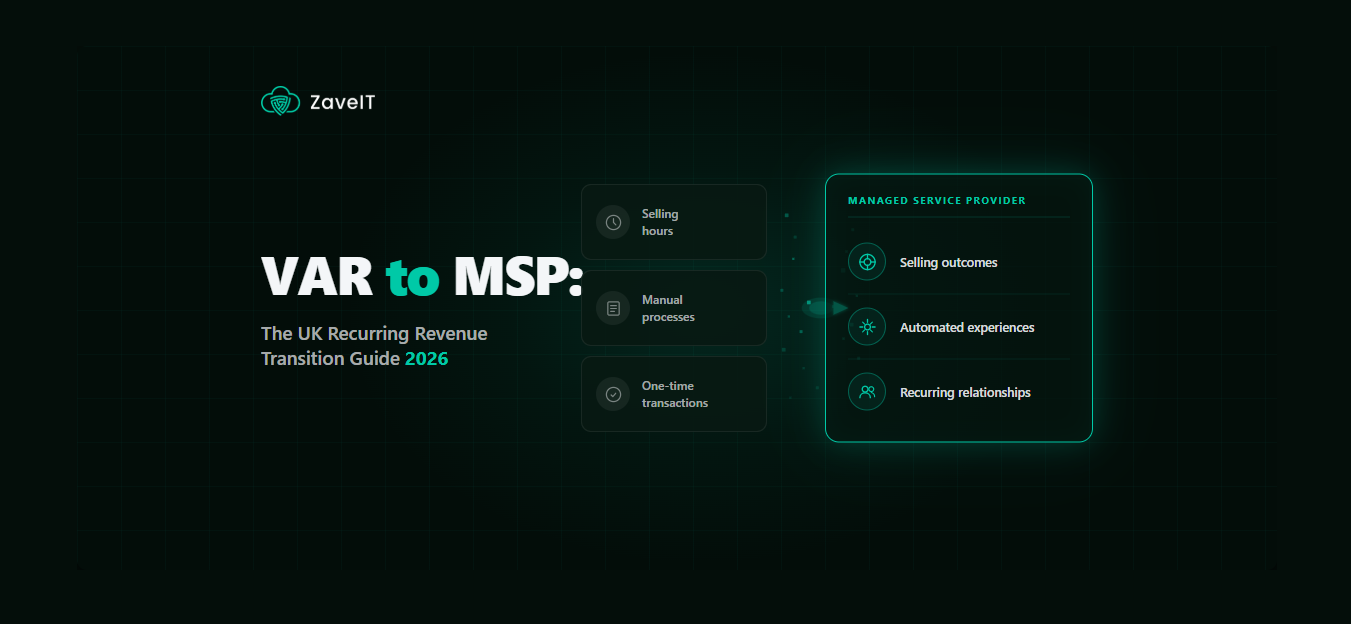
Starting in the 1980s, value-added resellers started bundling different software, networks, and systems for businesses. These VARs offered additional services beyond initial setup. With everything being on-premise, activities like installation and repair provided regular opportunities to have conversations, build trust, and maintain client relationships. And crucially, because monthly recurring revenue (MRR) didn’t exist, VARs had to focus on client engagement in order to make sales and stay in business.
In 1995, ConnectWise solved its own business problem—streamlining ticketing and operations—by developing its own PSA (now ConnectWise Manage).
Similar tools, like Autotask, came to the market shortly after, and soon PSAs became the industry standard in managing the operational side of an MSP.
In the 90s, remote IT helpdesks became more prevalent, and remote monitoring and management (RMM) continued to evolve in the early 2000s, so the VAR and IT repair space evolved to become managed services.
Customer engagement shifted from selling to onsite installation and repair. Maybe less sales-focused, but still engaged. But, as things shifted to the cloud, those regular face-to-face interactions dwindled—if any were to be had at all. And MSPs no longer had customer engagement.
Now MSPs are in a position of trying to create opportunities for customer engagement—not an ideal fit for people who don’t have enough time in the day to be support and sales. And in a digital-first environment, a couple of people can manage IT services—but they can’t manage all the customer services that go with it.
Many MSPs spend their time getting new customers instead of working more with the ones they do have. While MSPs can survive without good customer engagement, they have trouble retaining and growing existing accounts.
So, what do you need to scale an MSP? You need a fresh approach to a modern customer experience that makes things interesting and scalable for customers, and productive for MSPs.
That’s where a Zave-IT comes in.
Just as you rely on your PSA to help you manage your operations, you need a solution to automate your customer experience and buying journey. Automation is the only way to evolve and scale your MSP.
The market opportunity
MSPs today are doing more than ever—balancing subscription services, product sales, cloud migration, cybersecurity, and more. But as backend systems become more advanced, clients are expecting the same modern experience on the front-end.
In parallel industries, Digital Commerce Platforms (DCPs) are becoming the standard. The DCP market is projected to grow at 14.4% CAGR through 2028, driven by demand for self-service, transparency, and seamless integration.
For MSPs, this isn’t just about e-commerce. It’s about offering customers:
- A digital storefront for products and services
- A self-service experience that’s available 24/7
- A transparent view into current subscriptions, available add-ons, and service status etc.
By aligning your buying experience with how your customers already expect to shop, you build trust, increase conversions, and reduce friction.
ZaveIT helps MSPs create that front-end experience—without having to change the backend systems they already rely on.
What a digital commerce means for MSPs
A Digital Commerce Platform isn’t just a store. It’s a complete experience that connects what your client sees to what your systems deliver.
With ZaveIT, you can present:
- A modern, branded portal for clients
- A catalog of both subscription services and physical products
- Self-service workflows for purchasing, modifying, or upgrading services
- Integrated backend fulfillment through your PSA, billing, and provisioning stack
For clients, it feels like dealing with a cutting-edge tech partner. For you, it means less manual quoting, fewer emails, and more scalable engagement.
Why this matters
By offering customers a clear view into your service catalog and product offering, you move from reactive support to proactive enablement.
Instead of “Here’s what we fixed,” you’re saying: “Here’s how we can help you grow.”
That changes how clients perceive your value—and it creates new revenue opportunities that aren’t tied to tickets or QBRs.
For MSPs like you, this means:
A digital front-end experience enhances the great work you’re already doing. Here’s what you gain:
- Customer transparency: Customers understand what products and services are available, what they’re paying for, and how it benefits them. That builds trust and reduces churn.
- Scalable engagement: Instead of bespoke proposals for every client, you present a standard, well‑defined buying experience. You reduce friction, speed up sales, and free your team.
- Revenue growth: Offering self‑service upgrades, add‑ons, consumption‑based models means more opportunities for upsell and cross‑sell without heavy overhead.
- Operational alignment: When your front‑end is tied into your backend, you avoid manual hand‑offs, billing errors, and deployment delays. Efficiency increases.
- Strategic positioning: You move from being “just the IT guy” to being a partner that aligns technology with business outcomes—this elevates your value and expands your addressable budget.
Industry Perspective
The MSP industry is evolving—and MSPs are evolving with it.
Here are three trends shaping the future:
1. Seamless Integration is the New Standard
Today’s platforms must be API-ready and cloud-native. That means your digital commerce experience can (and should) connect seamlessly with your existing stack. The goal isn’t more tools—it’s smarter coordination.
2. Clients Expect to Buy Like Consumers
Whether it’s business software or hardware, buyers want the flexibility to browse, buy, and manage services on their own terms. MSPs who provide this become easier to work with—and harder to replace. Read more about the customer portal
3. Data-Driven Engagement
Commerce platforms are now intelligence platforms. They help you understand client behavior, anticipate needs, and drive proactive conversations based on usage trends and renewal signals.
Conclusion
You manage the tech behind the scenes, but your customers need to see the value. By leveraging a Digital Commerce Platform tailored for IT Business that gives them a compelling, transparent buying experience – perfectly aligned with your backend systems – you bridge the gap between invisible operations and visible value.
At ZaveIT, we believe your front‑end matters as much as your back‑end. Take the step: make your products and services visible, make buying frictionless, make scalability real.