Recurring revenue is one of the biggest reasons MSPs and IT resellers move towards managed services.
The logic is simple. Instead of winning a customer once and starting from zero on the next sale, you build an ongoing relationship around services, licences, support and subscriptions.
But there is a catch.
Recurring revenue is predictable for the customer. Managing it is not always predictable for the MSP.
As the number of customers, services, vendors and subscriptions grows, the work behind every recurring contract can become surprisingly complicated. New users need to be added. Licences change. Services get upgraded. Customers downgrade. Pricing changes. Renewals arrive. Invoices need to match what was actually sold.
And somewhere in the middle of all that, someone is usually opening a spreadsheet.
For a small IT business, this may be manageable.
For a growing MSP, it becomes a bottleneck.
The problem is not subscriptions themselves. The problem is what happens around them.
The subscription management problem starts small
Most MSPs do not deliberately create complicated subscription processes.
They evolve.
A customer starts with 20 Microsoft 365 licences.
Then they add backup.
Then security.
Then another five users.
Six months later, they want to upgrade part of the environment.
Another customer has a different pricing agreement.
A third customer has a legacy contract.
A fourth has a service that renews on a different date.
None of these decisions are unusual.
The challenge comes when the business has hundreds of these small changes happening across dozens or hundreds of customers.
Suddenly, the team needs to keep track of:
- What each customer has
- How many units they have
- What they pay
- When the subscription started
- When it renews
- Which supplier provides it
- What has changed
- What needs to be billed
- What needs to be delivered
- Who approved the change
This is where subscription management stops being an administrative task and becomes an operational problem.
Modern MSP platforms already recognise the complexity. Kaseya, for example, supports recurring services, different billing cycles, automated billing, customer-specific service changes and proration. ConnectWise similarly connects agreements and billing with customer and operational data.
The direction is clear: recurring services need more than an invoice at the end of the month.
They need structure.
Where do subscription bottlenecks actually come from?
There is rarely one single bottleneck.
Instead, several small inefficiencies build on each other.
1. Subscription information lives in too many places
This is probably the most familiar problem.
One person has the customer agreement.
Another has the pricing spreadsheet.
Finance has the billing information.
The supplier portal has the actual subscription quantity.
The account manager knows about the latest customer request.
Operations has a separate record of what is being delivered.
Everyone has part of the picture.
Nobody has the whole picture.
That creates a dangerous situation.
A subscription can be technically active but commercially wrong.
For example, a customer may be paying for 50 users while only using 43. Or they may have requested 10 additional licences that were provisioned but never added correctly to billing.
These may look like small discrepancies.
Across hundreds of subscriptions, they become margin leakage.
2. Every change becomes a manual task
Customers change.
That is normal.
The problem is when every change triggers a chain of manual work.
A customer adds ten users.
Someone updates the customer record.
Someone updates the supplier portal.
Someone changes the recurring charge.
Someone checks the invoice.
Someone informs delivery.
Someone updates the spreadsheet.
Someone eventually checks whether everything matches.
This is exactly the kind of workflow that feels harmless when you have 20 customers.
At 200 customers, it becomes a job in itself.
And when the business reaches 500 or 1,000 customers, the question changes from:
“Can we manage this?”
to:
“Why are people still managing this manually?”
3. Pricing becomes difficult to control
Subscription businesses rarely have one universal price.
MSPs may have:
- Standard pricing
- Customer-specific pricing
- Volume discounts
- Promotional pricing
- Bundled pricing
- Distributor pricing
- Different margins by customer segment
This flexibility is commercially useful.
But unmanaged flexibility creates problems.
A salesperson may use an old price.
A supplier may increase its cost.
A customer may still be on a legacy agreement.
A new quote may use a different margin from an existing contract.
Over time, the MSP can end up selling essentially the same service at several different prices without having a clear reason why.
This is one of the reasons leading MSP platforms put significant emphasis on centralised product and service information. ConnectWise, for example, positions its product catalogue as a central source for product information and pricing, including scheduled pricing updates.
The lesson is simple:
Subscription management starts with knowing exactly what you are selling and at what price.
4. Renewals become reactive instead of strategic
A renewal should not be a surprise.
Yet for many businesses, renewal management still looks something like this:
Renewal date approaches → reminder appears → someone checks the account → customer is contacted → changes are discovered → billing is adjusted.
That is reactive.
A better approach is to treat the subscription lifecycle as an ongoing process.
A subscription should have visibility from the moment it is created through:
Quote → Order → Provisioning → Active Subscription → Change → Renewal → Expansion or Cancellation
This creates an important difference.
Instead of asking:
“What renewals do we have this month?”
the business can ask:
“What is happening across our subscription base?”
Which customers are expanding?
Which services are being reduced?
Where are upgrades happening?
Which subscriptions are underperforming?
Where are margins changing?
That is much more valuable information.
5. Billing does not always match reality
This is where subscription management becomes directly connected to profitability.
Imagine an MSP has 300 customers.
Each customer has a mixture of:
- Per-user services
- Per-device services
- Software licences
- Managed services
- Support packages
- One-off charges
- Add-ons
Now imagine that customers change quantities throughout the month.
Someone needs to make sure the billing reflects those changes.
This is why features such as automated billing and proration exist in modern MSP platforms. Kaseya's billing functionality, for example, supports recurring services and automatically calculated prorations when service quantities or effective dates change.
The underlying principle is bigger than billing automation.
The commercial system needs to stay connected to the customer's actual service configuration.
Otherwise, revenue becomes dependent on someone remembering to update something.
Subscription management is not just a finance problem
This is an important distinction.
Finance may own invoicing.
But subscription management touches almost every part of an MSP.
Sales
Needs to know what can be sold, at what price and under what conditions.
Finance
Needs accurate recurring charges and visibility into billing.
Operations
Needs to know exactly what the customer has purchased.
Procurement
Needs to know what needs to be ordered from suppliers.
Support
Needs visibility into the services and entitlements attached to the customer.
Customer success
Needs to understand changes in the customer's relationship with the MSP.
Leadership
Needs reliable visibility into recurring revenue, customer growth and service profitability.
If each team works from a different source of information, the subscription lifecycle becomes fragmented.
And fragmented processes are difficult to scale.
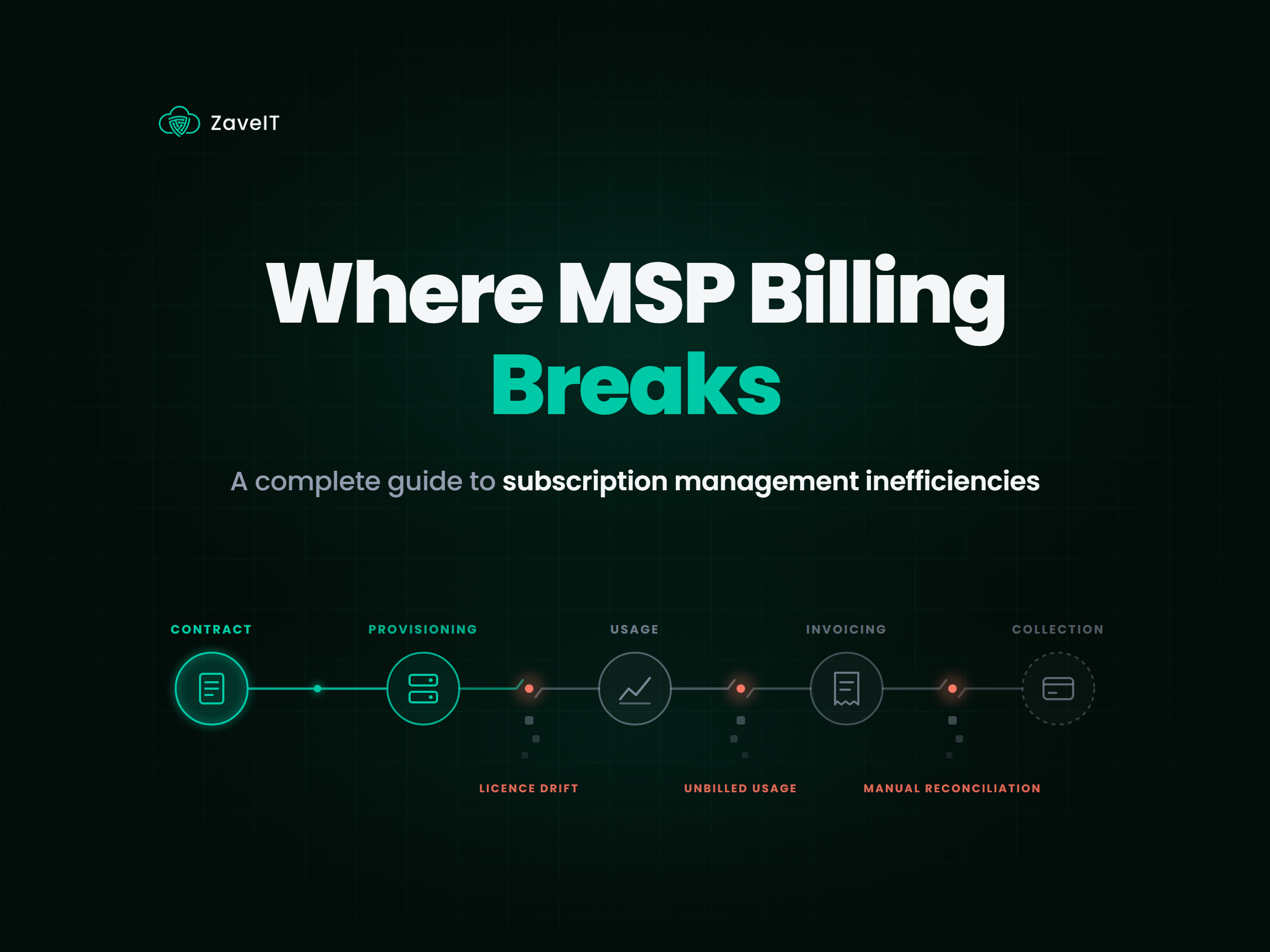
The real bottleneck: disconnected systems
This is where many MSPs find themselves.
The customer journey may look simple from the outside.
Customer chooses a service → Customer pays → Service is delivered
Behind the scenes, however:
Quote → CRM → Supplier portal → Spreadsheet → PSA → Finance → Invoice → Delivery → Customer portal
Every handoff introduces another opportunity for something to be missed.
That could mean:
- An incorrect quantity
- A missed renewal
- A wrong price
- A delayed provisioning request
- A billing discrepancy
- A customer waiting for an update
- An internal team chasing information
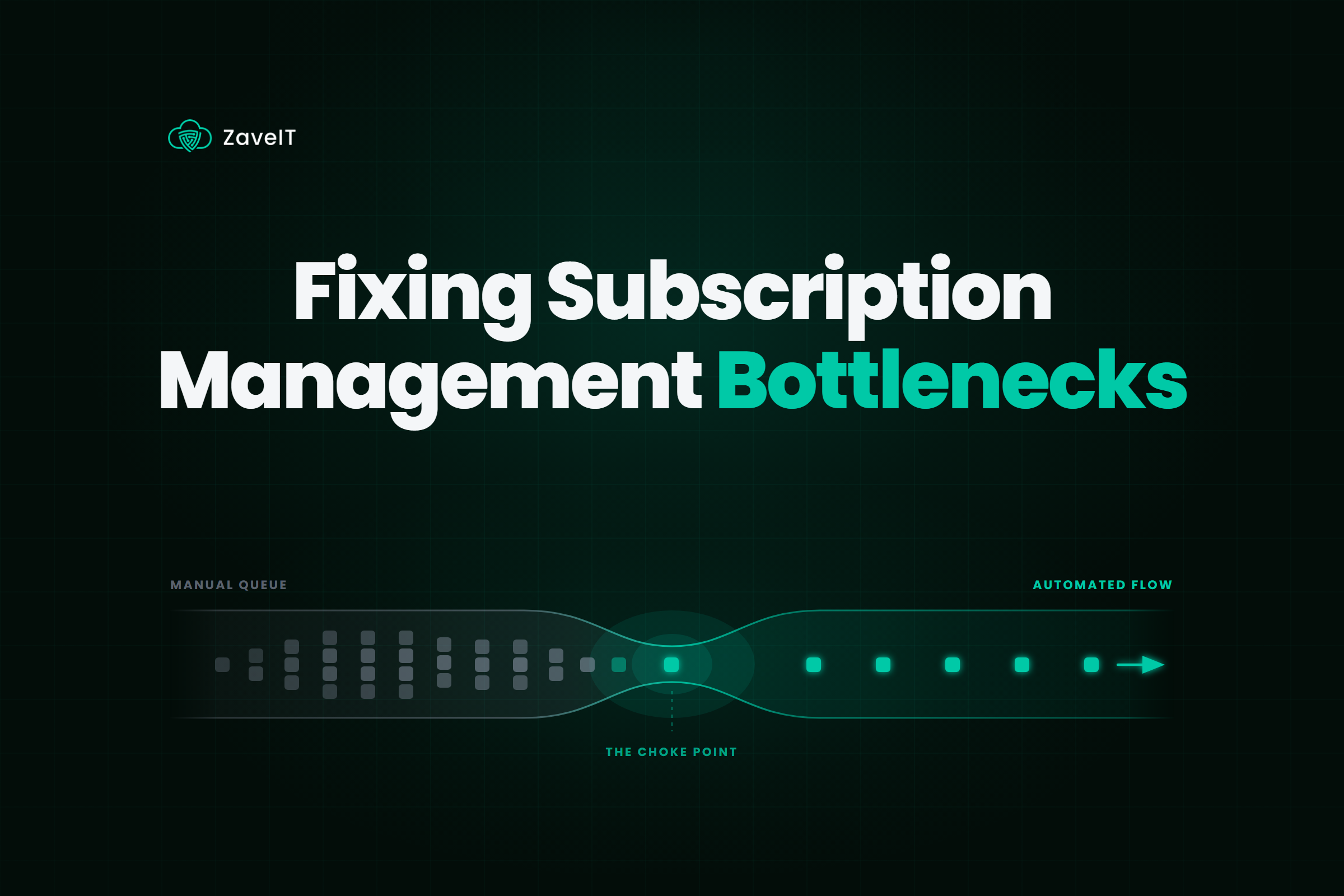
Adding more people can temporarily absorb the workload.
But that does not fix the underlying process.
It simply makes the process more expensive.
What does better subscription management look like?
The answer is not necessarily “automate everything”.
Some customer decisions should remain human.
Complex requirements need conversations.
Strategic accounts need account management.
Large changes may need approval.
The goal is to automate the repetitive parts while giving people better visibility over the decisions that actually need them.
A stronger subscription workflow might look like this:
1. Build
Create a clearly defined service or product with pricing, billing cycle, dependencies and delivery requirements.
2. Sell
Make the subscription available through the appropriate sales channel, customer portal or sales process.
3. Order
Capture the customer's purchase and the exact quantities or options selected.
4. Provision
Trigger the appropriate internal or supplier workflow.
5. Activate
Create the customer's active subscription and establish the recurring billing relationship.
6. Manage
Handle upgrades, downgrades, quantity changes and additional services without rebuilding the process every time.
7. Renew
Keep renewal information visible and connected to the customer relationship.
8. Expand
Make it easier to identify and sell relevant additional services.
That is the difference between managing subscriptions and building a subscription operation.
Start with the service, not the subscription
One of the easiest mistakes is to think of subscription management as purely a billing problem.
It is not.
The quality of the subscription depends on the quality of the service behind it.
For example:
“Managed Endpoint Security – £X/user/month”
is not enough.
The MSP needs to know:
- What is included?
- Which technology is used?
- What is the minimum quantity?
- What does onboarding involve?
- What support level applies?
- How is it billed?
- What happens when a user is added?
- What happens when a user is removed?
- What other services does it depend on?
This is why a structured service catalogue becomes so important.
ZaveIT's approach is to connect products, services, bundles, pricing, customer-facing channels and delivery workflows through one structured catalogue.
Instead of treating the subscription as a separate financial object, the service itself becomes the foundation.
That creates much stronger continuity between what was sold and what eventually gets billed and delivered.
The customer should not have to email for everything
There is another bottleneck that is easy to overlook.
The customer.
If a customer wants to add five licences, upgrade a service or explore another solution, do they have to:
Email → Wait → Receive a quote → Approve → Wait again
for something that could be a straightforward purchase?
Not every service should be self-service.
But many repeatable services can be.
Modern customer portals and online stores are increasingly being used to let customers browse products, manage subscriptions and place orders. Kaseya, for example, provides a store experience where customers can view subscriptions and billing information and purchase products. ConnectWise also supports customer portals with billing, service catalogue and quote capabilities.
For MSPs, this creates a bigger opportunity.
Your existing customers already know you.
You do not necessarily need to “sell” to them from scratch every time.
You need to make it easier for them to discover what else you can provide.
That turns subscription management into a potential growth channel, not just an administrative function.
Five practical ways to remove subscription bottlenecks
1. Create one source of truth
Stop relying on separate spreadsheets for services, pricing and subscription information.
Create a structured source that sales, finance and operations can work from.
Everyone should know where the current information lives.
2. Standardise repeatable services
If you sell the same service repeatedly, define it once.
Set its:
- Scope
- Pricing
- Billing model
- Dependencies
- Delivery requirements
- Customer-facing information
Then reuse it.
You should not have to redesign a service every time you sell it.
3. Automate predictable changes
Look for events that happen repeatedly:
Add user → update quantity → update subscription → update billing
or:
Customer orders service → create order → assign delivery → activate subscription
These are excellent candidates for automation.
The objective is not to remove people.
It is to stop using people as connectors between systems.
4. Give customers appropriate self-service
Identify the services customers can confidently order without a sales conversation.
Publish those through a branded customer portal or online sales channel.
This can reduce administrative workload while creating more opportunities for expansion.
ZaveIT supports customer-facing catalogues through customer portals, webshops and embedded experiences, alongside order and delivery workflows.
5. Measure the subscription business, not just total revenue
MRR and ARR are useful.
But they do not tell the whole story.
Look at:
- Subscription growth
- Expansion revenue
- Downgrades
- Churn
- Average revenue per customer
- Service-level margins
- Renewal rates
- Billing discrepancies
- Manual processing time
These metrics help you understand whether recurring revenue is actually becoming easier to scale.
What should MSPs automate first?
A useful rule is:
Automate frequency before complexity.
You do not need to start with the most sophisticated workflow.
Start with the things your team does repeatedly.
For example:
Customer adds licences
→ Update subscription
→ Adjust quantity
→ Trigger provisioning
→ Update recurring billing
Or:
Customer orders a managed service
→ Create order
→ Assign delivery workflow
→ Notify responsible team
→ Activate subscription
→ Start recurring billing
Once these workflows are stable, more complex automation becomes easier.
The goal is not more automation. It is less friction.
There is a tendency in the MSP industry to treat automation as the end goal.
It is not.
A fully automated bad process is still a bad process.
Before automating, ask:
Why does this task exist?
Why does this information need to be entered twice?
Why does someone have to approve this manually?
Why does the customer need to email us?
Why does finance need to reconcile this every month?
Sometimes the best automation is removing the unnecessary step entirely.
From subscription management to subscription growth
This is the bigger opportunity for MSPs.
A well-managed subscription base should not simply produce predictable invoices.
It should give the business a better understanding of its customers.
If a customer has your backup service but not your security service, is there a relevant opportunity?
If a customer has increased user numbers three times this year, what does that tell you?
If a customer consistently adds services at renewal, could the account team engage earlier?
If a service has strong demand but poor margins, should it be repriced or redesigned?
Once subscription information is structured and connected, these questions become easier to answer.
That is when subscription management starts moving from back-office administration to commercial intelligence.
The MSP scaling test
Here is a simple test.
Imagine doubling your customer base next year.
Would your subscription process:
A. Require roughly twice as much administrative work?
B. Require some additional work, but most processes remain manageable?
C. Handle significantly more customers because the core workflows are already structured and automated?
If your answer is A, the problem is probably not your subscription model.
It is your operating model.
Recurring revenue is supposed to make growth more predictable.
If every new subscription creates another manual process, the business eventually starts scaling its administration faster than it scales its revenue.
That is not the kind of recurring revenue model MSP owners want.
Fix the bottleneck before it becomes the business
Subscription management becomes difficult when the business grows faster than the processes supporting it.
More customers mean more subscriptions.
More subscriptions mean more changes.
More changes mean more handoffs.
More handoffs mean more opportunities for errors, delays and revenue leakage.
The answer is not simply hiring another person to maintain the spreadsheet.
It is creating a connected operating model where the service catalogue, pricing, customer purchase, subscription, billing and delivery process work together.
That allows your team to spend less time asking:
“Where is that information?”
and more time asking:
“How can we grow this customer?”
That is the real shift.
From managing subscriptions manually to building a subscription business that can scale.
Build a better foundation for recurring revenue
ZaveIT helps MSPs and IT resellers connect products, services, pricing, customer-facing sales channels, subscriptions and delivery workflows in one structured platform.
The goal is not simply to automate another administrative task.
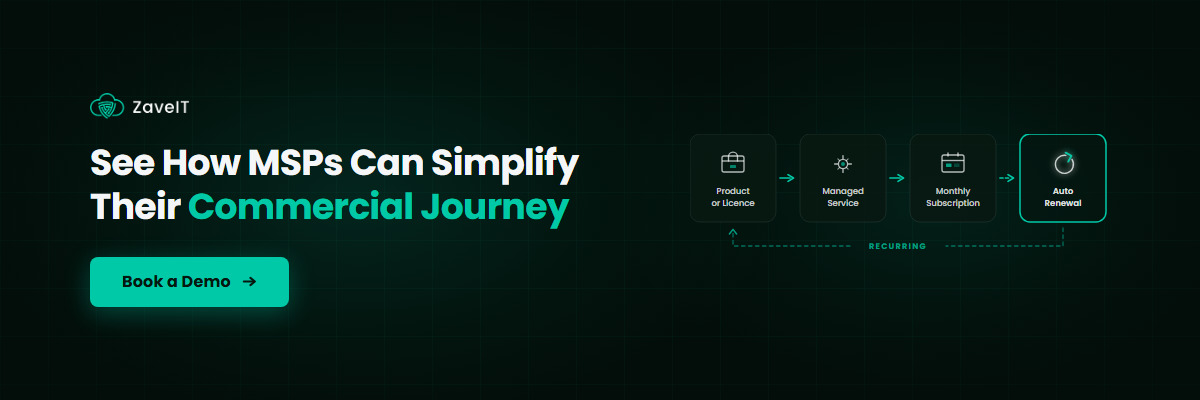
It is to make the journey from service → sale → subscription → delivery → recurring revenue more connected and repeatable.
If your recurring revenue is growing faster than your processes can handle, it may be time to fix the bottleneck before it becomes your next growth ceiling.
Explore ZaveIT Service Catalogue Management