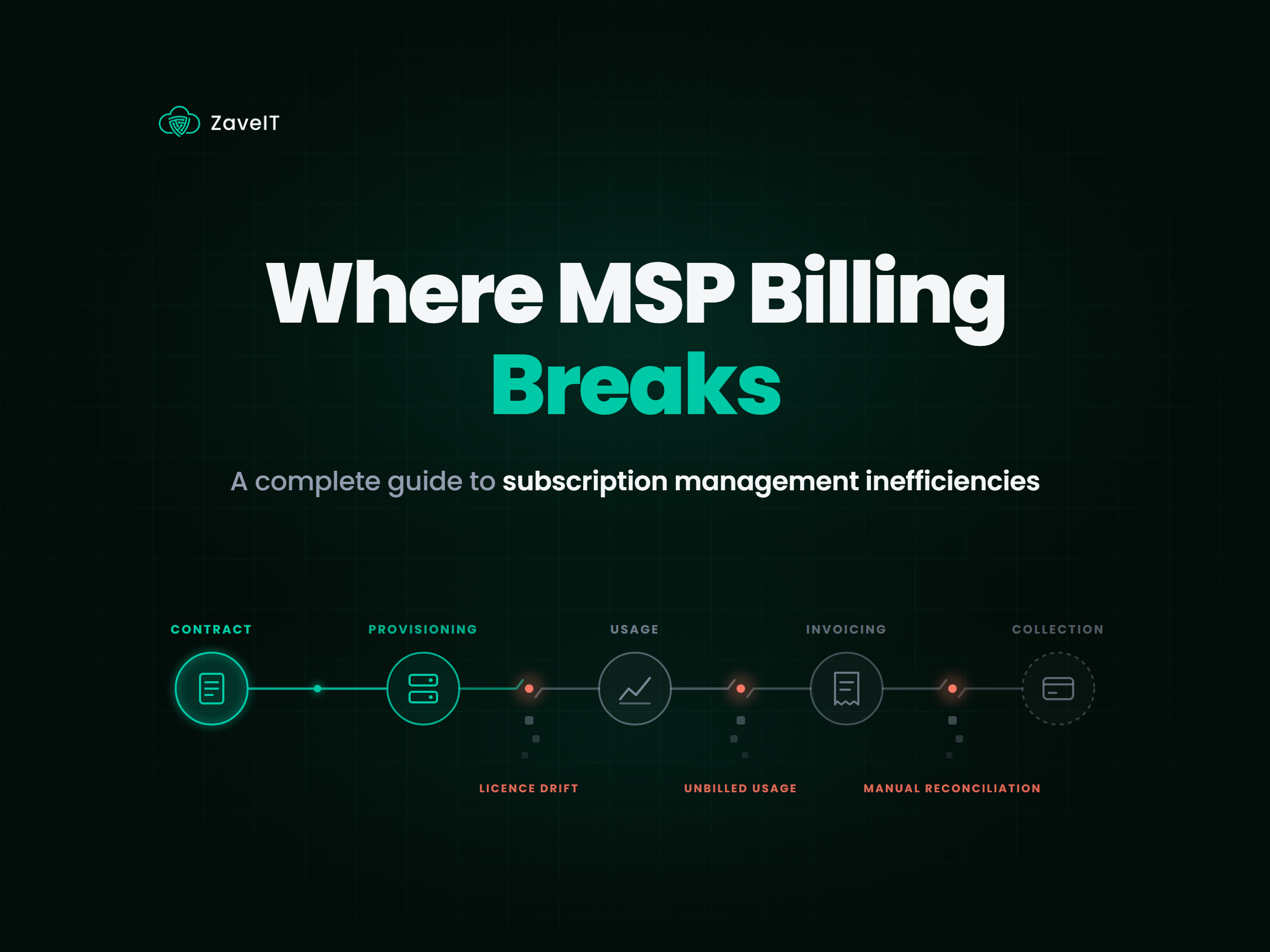
Recurring revenue should make an MSP business more predictable.
Yet the operational work behind it is often anything but predictable.
A customer adds five licences. Another removes three users. A vendor changes pricing. A cloud service generates variable consumption. A contract renews next month. A customer upgrades a managed service halfway through its billing period.
None of these events is unusual on its own. The problem starts when every change has to move through several systems, spreadsheets, inboxes and people before the customer is billed correctly.
That is where subscription management inefficiencies begin.
For MSPs and IT resellers, they rarely come from one obviously broken process. They emerge from small gaps between ordering, vendor data, subscription records, service delivery, renewal management and invoicing.
Those gaps create work. More importantly, they create uncertainty around whether everything being delivered is actually being billed.
What are subscription management inefficiencies?
Subscription management inefficiencies are operational gaps that prevent subscription changes, usage, pricing, renewals and customer information from moving accurately through the recurring billing lifecycle.
For an IT service provider, they commonly appear when:
- licence changes have to be updated manually
- vendor or distributor data sits separately from customer billing records
- price changes are tracked in spreadsheets
- customer upgrades or cancellations arrive through email
- usage information has to be reconciled before invoicing
- renewal dates are maintained separately from subscription records
- different teams hold different versions of customer information
- invoices require extensive manual checking before they can be issued
This distinction matters.
A billing error may appear on an invoice.
A subscription management inefficiency usually happens before the invoice is created.
The invoice is simply where the problem becomes visible.
Why MSP subscription billing becomes complicated so quickly
Subscription billing sounds simple when described as:
Customer subscribes → MSP delivers service → customer receives recurring invoice.
Real MSP billing rarely follows such a clean path.
A single customer might purchase Microsoft licences, backup, cybersecurity, cloud consumption, connectivity and the MSP's own managed services.
Each component can behave differently.
One service may be billed per user. Another per device. Another according to consumption. Another may have an annual commitment but monthly billing. A managed service may include both a fixed recurring fee and variable components.
Even within one vendor ecosystem, billing can involve fixed subscriptions, usage-based charges, credits, licence changes and different renewal conditions. Microsoft's CSP documentation, for example, distinguishes between fixed-fee and usage-based services and provides detailed reconciliation records so partners can match charges, subscriptions and customer usage.
Microsoft also notes that licence-based price lists can change monthly, while some usage-based prices may change during the month. Subscription pricing can also behave differently at renewal, upgrade or term conversion.
Multiply that complexity across several vendors and hundreds of customers, and billing stops being a finance-only workflow.
It becomes a data coordination problem.
The seven workflow gaps behind most subscription management inefficiencies
The easiest way to understand MSP billing problems is not to start with invoicing.
Start with the journey a service takes from catalogue to customer to subscription to renewal.
There are seven places where that journey commonly breaks.
1. The service catalogue and the billing record do not share the same source of truth
Many MSPs have a perfectly good list of the services they sell.
The difficulty is that the same information often exists in several places.
Sales may have one price.
Finance has another.
The distributor has the current cost.
An older customer may have negotiated pricing.
The contract defines a specific term.
The PSA contains yet another service description.
None of these systems is necessarily wrong.
The problem is deciding which one is right when it is time to bill the customer.
A structured service catalogue reduces this ambiguity by connecting the definition of the service with pricing, ordering, subscriptions and downstream workflows.
The important point is not simply to replace Excel.
It is to stop recreating the commercial definition of a service every time somebody sells, changes or renews it.
2. Orders and subscriptions are treated as separate processes
A customer order is not the end of the transaction for a recurring service.
It is the beginning of the subscription lifecycle.
Consider a simple upgrade.
A customer requests another ten licences.
Someone records the request.
The vendor quantity changes.
The customer subscription changes.
The cost changes.
The selling price may change.
A prorated adjustment may be required.
The next invoice has to reflect the correct amount.
If each step depends on somebody noticing the previous step has been completed, the workflow contains unnecessary risk.
The same issue applies to:
- new subscriptions
- upgrades
- downgrades
- add-ons
- cancellations
- pauses
- quantity changes
- billing-frequency changes
- contract extensions
Microsoft's Partner Center, for example, supports scheduled changes at renewal including upgrades, licence increases or reductions, billing-term changes and billing-frequency changes. That illustrates why the subscription itself needs to be treated as a changing commercial object rather than a static billing line.
The more subscription events an MSP handles, the less practical manual handoffs become.
3. Supplier cost and customer billing are reconciled too late
Invoice day should not be the first time an MSP discovers that supplier data and customer records disagree.
Yet this happens frequently when billing relies on end-of-month reconciliation.
Someone downloads vendor information.
Someone compares it against internal records.
Differences are investigated.
Quantities are corrected.
Missing services are added.
Credits are reviewed.
Usage is checked.
Then invoices can finally be prepared.
The process may work.
But it concentrates a month's worth of uncertainty into a few days.
A better model is continuous or exception-based reconciliation.
Instead of asking:
“Can we reconcile everything before invoicing?”
the question becomes:
“Can the system continuously identify the few things that do not reconcile?”
That is a much more scalable problem to solve.
Microsoft's own CSP billing guidance reflects the importance of reconciliation. Its reconciliation files are specifically designed to help partners compare charges, credits, usage and subscription information and use that information when creating customer invoices.
4. Mid-cycle changes rely on memory and manual intervention
Subscriptions rarely remain unchanged for their entire term.
Customers hire employees.
Employees leave.
Projects start.
Cloud consumption rises.
Devices are added.
Services are upgraded.
Licences are removed.
Every mid-cycle change creates a billing event that has to be interpreted correctly.
Should it be prorated?
Should the customer be billed immediately?
Does the supplier allow the quantity reduction?
Does the new price apply now or at renewal?
Does the service change affect another bundled service?
This is where apparently small subscription management inefficiencies turn into revenue leakage.
The problem is not necessarily that the MSP cannot process the change.
It is that somebody has to remember all the downstream implications.
Modern subscription billing systems deal with these complexities through defined rules for billing dates, usage, prorations, payment schedules, credits and subscription changes rather than asking staff to calculate every variation manually.
5. Renewals live in calendars, spreadsheets and people's heads
A renewal date is much more than a reminder.
It can trigger:
- customer communication
- pricing review
- supplier price validation
- contract changes
- service review
- licence adjustment
- upsell conversations
- cancellation decisions
- new commercial terms
When renewal management is disconnected from subscription management, teams often have visibility of the date but not the complete commercial context around it.
That makes renewal management reactive.
Someone notices a contract expires in 30 days.
Then the search begins.
What is the customer currently buying?
What are we paying the supplier?
Did the vendor change its pricing?
Which discount did we agree?
Has usage changed?
Is the customer still on the right package?
A mature recurring revenue management workflow treats renewal as part of the subscription lifecycle, not as a separate sales task.
6. Customers cannot make simple subscription changes themselves
There is another source of inefficiency that MSPs sometimes overlook:
the customer is forced to create manual work.
A customer needs another licence.
They email the account manager.
The account manager forwards the request.
Operations updates the service.
Finance updates the billing record.
Someone confirms the change with the customer.
The request itself may have taken the customer less than a minute to describe.
Processing it required four people.
Now repeat that across hundreds of customers.
Self-service changes the economics of these interactions.
A properly controlled customer portal can allow customers to view subscriptions, review invoices, place orders and manage permitted subscription actions without turning every routine request into an internal ticket.
Self-service subscription management is already common in modern recurring billing systems. Stripe, for example, supports customer actions including viewing invoices, updating payment details and managing upgrades, downgrades, pauses or cancellations through a customer portal.
For MSPs, the principle extends beyond payment details.
Customers should be able to handle appropriate commercial actions themselves while the platform applies the MSP's catalogue, pricing, permissions and workflow rules behind the scenes.
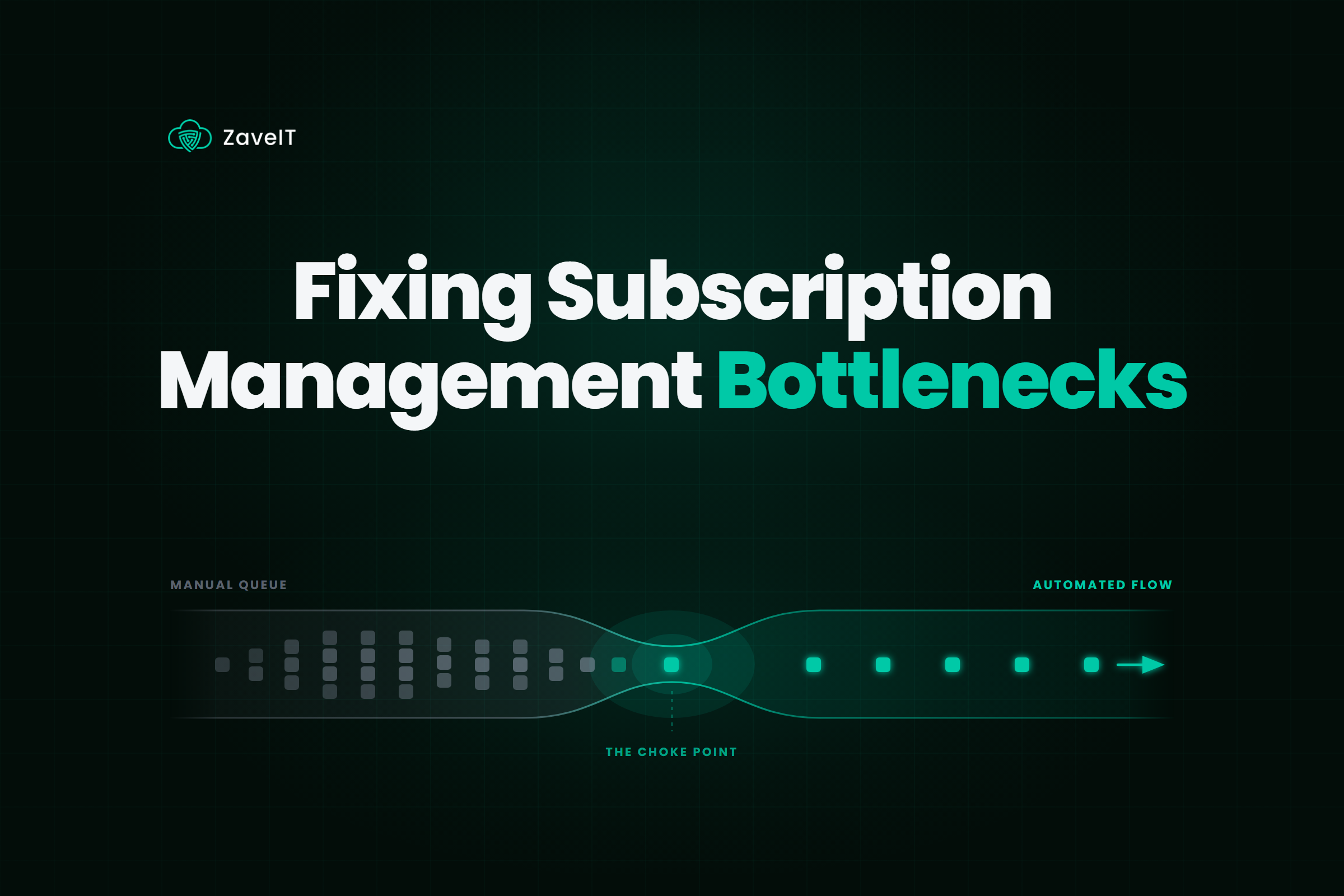
7. Automation starts too late
One of the most common mistakes in billing automation is automating invoice generation while leaving everything before it manual.
That produces invoices faster.
It does not necessarily produce better billing.
True MSP billing automation begins much earlier.
It begins when the service is defined.
Then it continues when the customer orders it.
The same information should flow into subscription creation, service delivery, billing and renewal.
A useful way to think about this is:
Catalogue → Price → Order → Subscription → Delivery → Usage → Invoice → Renewal
If information has to be repeatedly copied between these stages, automation is incomplete.
The objective should not be “automated invoices”.
The objective should be an automated commercial workflow.
Where does revenue leakage happen in MSP subscription billing?
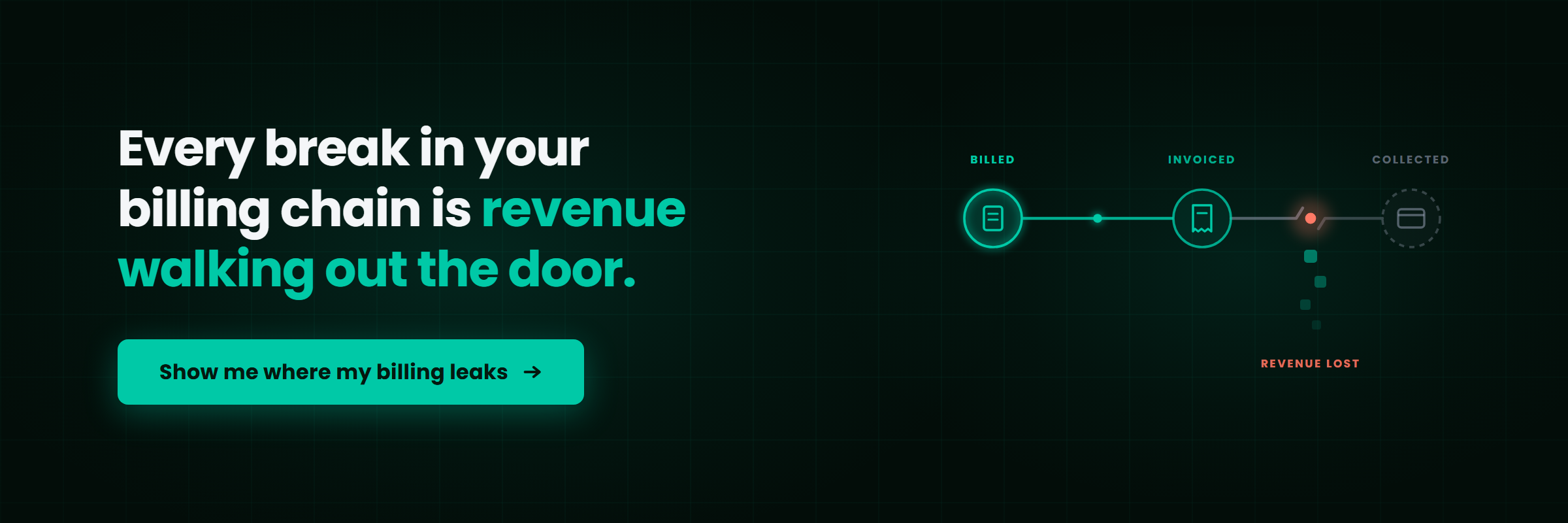
Revenue leakage is often imagined as one large missed charge.
In reality, it is more likely to be a collection of small mismatches.
For example:
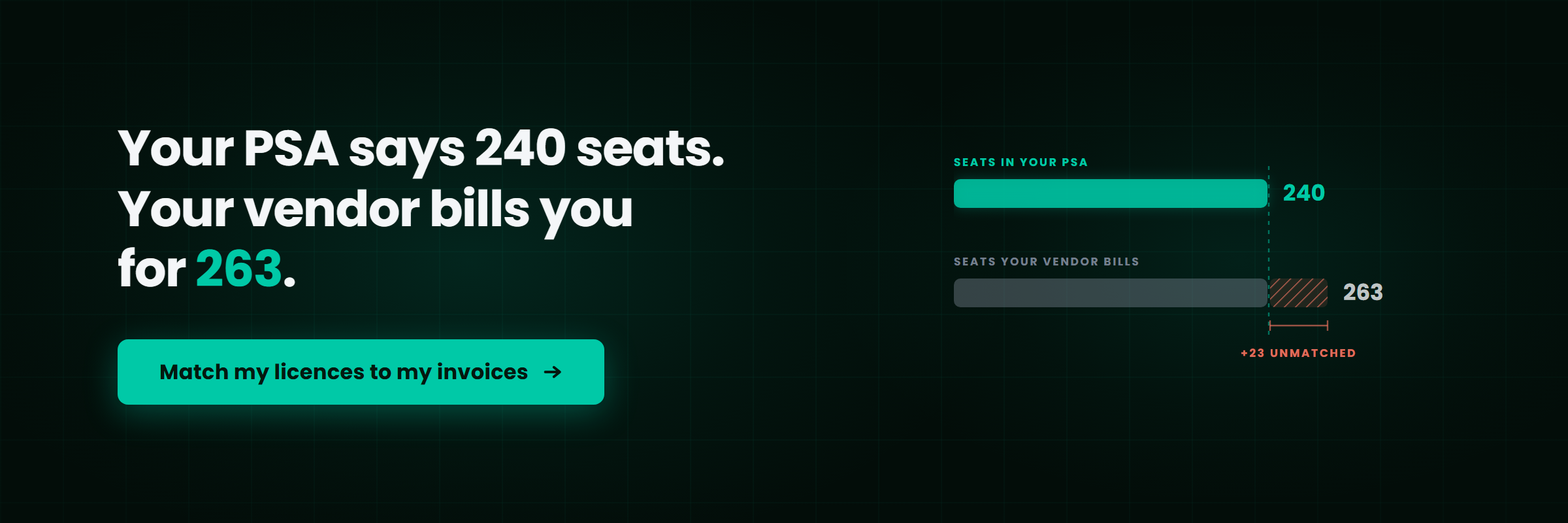
A customer receives 52 licences but is billed for 49.
A managed service starts on Monday but is added to the billing system next month.
A customer upgrades but remains on the previous price.
A supplier increases its price while the customer's selling price remains unchanged.
A usage charge never reaches the invoice.
A cancelled service continues to generate supplier cost.
A customer receives an add-on that never appears in the subscription record.
A renewal happens using an outdated commercial agreement.
Each event may look minor.
The recurring nature of the business makes it significant.
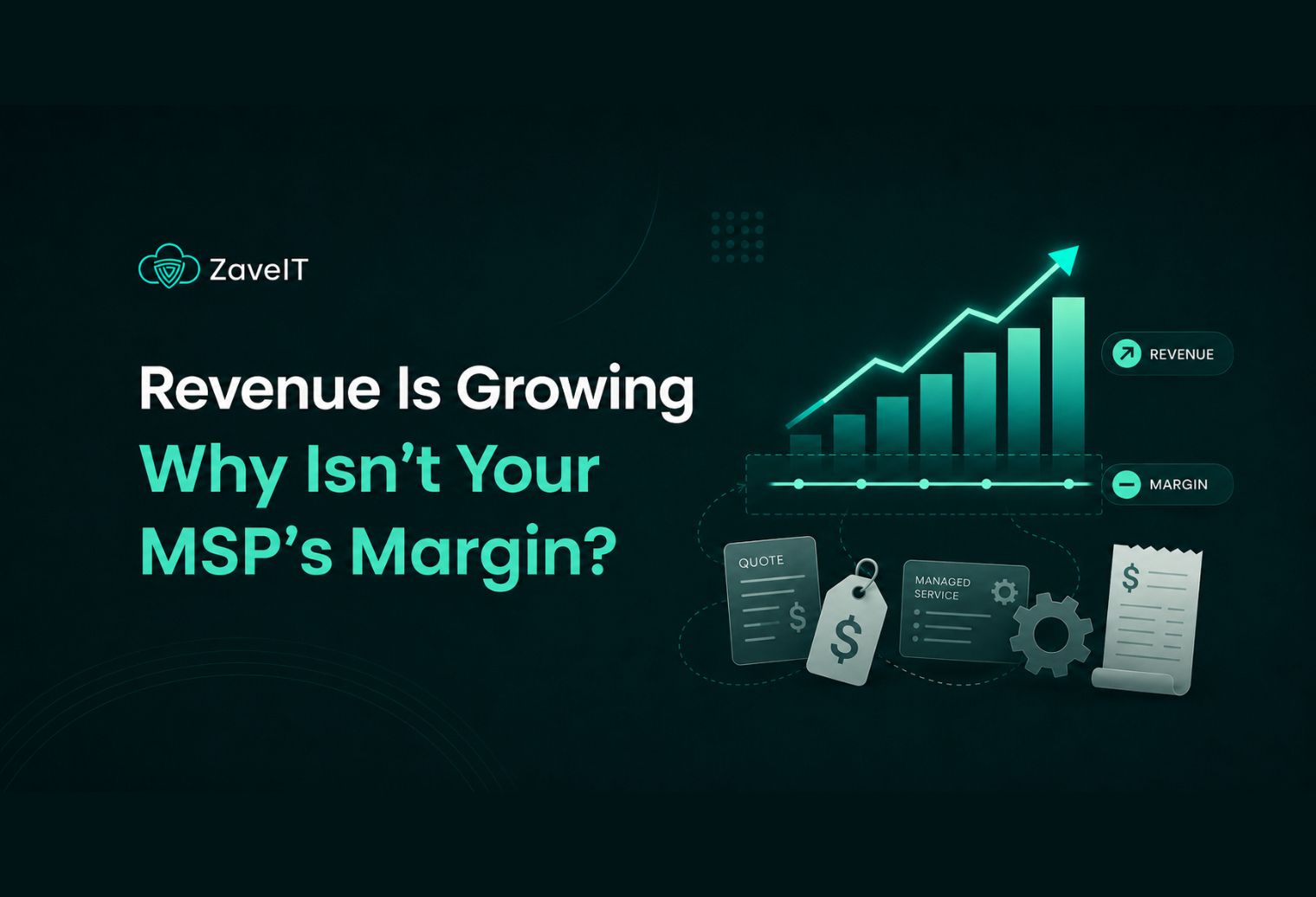
A £20 discrepancy is not always a £20 problem.
If it repeats every month across many customers, it becomes a margin problem.
That is why recurring revenue management requires visibility into both sides of the equation:
What are we delivering and paying for?
and
What are we charging the customer for?
What does an efficient MSP billing workflow look like?
There is no single perfect billing architecture for every IT service provider.
But efficient models tend to share several characteristics.
One commercial definition of every service
The service catalogue should define what is being sold, how it is packaged, how it is priced and how it behaves commercially.
That definition should then feed downstream processes rather than being recreated by different departments.
Subscription changes are captured as events
An upgrade, downgrade, cancellation, quantity change or renewal should become a structured event.
The platform can then determine what needs to happen next.
People should manage exceptions.
They should not have to manually reproduce routine subscription logic.
Vendor and distributor data flows into the billing process
Where integrations are available, licence quantities, usage information, costs and product information should be synchronised rather than periodically copied.
Automation cannot remove every reconciliation requirement.
It can dramatically reduce what humans need to reconcile.
Customers can self-serve where appropriate
Not every customer action requires approval from an account manager.
MSPs should determine which actions can safely be delegated through a customer portal.
For example:
- requesting additional services
- ordering approved products
- viewing subscriptions
- viewing invoices
- accessing documents
- requesting changes
- reviewing renewal information
The customer's action should then initiate the relevant commercial workflow.
Exceptions become visible
The goal of automation is not to pretend exceptions do not exist.
It is to make them obvious.
If a distributor reports 75 licences while the customer subscription contains 72, that discrepancy should become an exception to investigate.
The operations team should not have to compare two 5,000-row spreadsheets to discover it.
Subscription billing vs subscription management: what is the difference?
The terms are related, but they are not identical.
Subscription billing concerns the financial calculation and collection associated with a recurring service: billing frequency, charges, usage, credits, prorations, invoices and payments.
Subscription management covers the wider lifecycle of the subscription: creation, activation, upgrades, downgrades, quantities, renewals, cancellation, customer access and the relationship between the subscription and the underlying product or service.
For MSPs, effective recurring revenue management requires both.
A sophisticated billing engine cannot correct an inaccurate subscription record.
And a well-maintained subscription database cannot protect margin if supplier costs and customer invoices remain disconnected.
How integrated automation reduces subscription management inefficiencies
The real value of integrated automation is not simply speed.
It is continuity.
When systems share the same commercial information, each event can trigger the next action without asking somebody to re-enter what the organisation already knows.
A customer orders a service.
The subscription is created.
The delivery workflow begins.
The correct commercial rules apply.
The customer sees the subscription.
Changes remain attached to that subscription.
Usage or supplier information feeds the billing process.
Renewal remains connected to the same record.
That is fundamentally different from automating individual tasks.
It is also the direction ZaveIT takes with its MSP platform. Its service catalogue connects products and services with sales channels, customer portals and delivery workflows, while its customer management environment includes orders, subscriptions and recurring-revenue information.
ZaveIT's customer portal also allows customers to interact with subscriptions, invoices, services and orders through the same commercial environment rather than creating separate manual requests for every action.
The wider principle is more important than any individual feature:
Subscription efficiency improves when the commercial journey stays connected from the moment a service is created to the moment it is renewed.
How to identify subscription management inefficiencies in your MSP
You do not need a major billing failure to know there is a problem.
Start by looking at the work your team performs every month.
Ask:
How many spreadsheets have to be opened before invoices can be approved?
How many vendor portals need to be checked manually?
How often does finance ask operations to confirm quantities?
How many subscription changes arrive through email?
How many customer requests need to be copied into another system?
How often do account managers need to check renewal dates manually?
How difficult is it to explain exactly why a customer was charged a particular amount?
How quickly can you identify a service you are paying for but not billing onward?
How many invoice lines require human correction each month?
If the answers depend heavily on individual knowledge, the organisation probably has a workflow problem even if invoices are still going out on time.

What MSP leaders should automate first
Trying to automate the entire recurring revenue lifecycle at once is usually unnecessary.
Start where repeated manual handling and financial risk overlap.
For many MSPs, the priority order is:
- Centralise the service catalogue so pricing, packages and subscription rules have a clear source of truth.
- Connect ordering with subscription creation so a sale does not become a second administrative process.
- Integrate vendor, licence and usage information wherever reliable APIs or data feeds exist.
- Automate routine billing rules including recurring charges, usage and permitted adjustments.
- Create exception-based reconciliation rather than checking every transaction manually.
- Connect renewals to subscriptions and current pricing.
- Introduce customer self-service for routine orders, subscription visibility and approved changes.
The target is not zero human involvement.
Some commercial decisions should remain human.
Pricing exceptions, contract negotiations, unusual credits and disputed charges often need judgement.
Automation should remove repetitive administration so people can spend more time on exactly those exceptions.
The real question is not whether your invoices are correct today
Most established MSPs can produce an invoice.
That is not the same as having an efficient recurring revenue operation.
A billing process can appear functional while depending on spreadsheets, individual knowledge and repeated reconciliation behind the scenes.
That model becomes increasingly expensive as the business adds customers, suppliers, licences, consumption-based services and pricing models.
The better question is:
How much manual coordination is required to make each invoice correct?
If the answer grows with every new customer, the constraint is not your billing software alone.
It is the workflow connecting your service catalogue, customer orders, subscriptions, vendors, usage, billing and renewals.
Removing those subscription management inefficiencies is what allows an MSP to grow recurring revenue without increasing administrative effort at the same rate.
And that is ultimately what billing automation should achieve.
Frequently Asked Questions
What causes subscription management inefficiencies for MSPs?
Subscription management inefficiencies usually result from disconnected systems, manual licence and usage reconciliation, inconsistent service information, separate renewal tracking and repeated data entry between sales, operations and finance. They become more noticeable as an MSP adds customers, vendors and recurring services.
How do subscription management inefficiencies cause revenue leakage?
Revenue leakage occurs when the service being delivered no longer matches the service being billed. Examples include missed licence increases, unbilled usage, outdated pricing, forgotten add-ons and supplier services that are being paid for but are not invoiced to the customer.
What is MSP billing automation?
MSP billing automation uses integrated systems and workflow rules to move subscription, pricing, licence, usage and customer information through the billing lifecycle with less manual intervention. Effective billing automation begins before invoice generation and connects ordering, subscriptions, service delivery, reconciliation and renewals.
Why is subscription billing difficult for IT service providers?
IT service providers often combine fixed recurring charges, per-user licences, per-device services, usage-based cloud services and vendor subscriptions in the same customer relationship. Different billing frequencies, contract terms, quantity changes and vendor pricing rules make manual management increasingly difficult as the business grows.
How can self-service reduce MSP billing workload?
Self-service portals allow customers to complete permitted actions such as reviewing subscriptions, viewing invoices, ordering services and requesting subscription changes without relying on email or account-manager intervention. When those actions connect directly with subscription and billing workflows, they remove repetitive administrative handoffs.
What is the difference between billing automation and recurring revenue management?
Billing automation focuses on automating billing-related tasks such as charges, invoicing, usage and reconciliation. Recurring revenue management is broader and includes the entire commercial lifecycle, from service definition and subscription creation through changes, billing, renewals and retention.
How can MSPs reduce manual subscription reconciliation?
MSPs can reduce manual reconciliation by connecting vendor and distributor data with customer subscription records, maintaining one structured service catalogue, automatically capturing subscription changes and using exception-based reviews to identify only records that do not match.
Can billing automation completely replace manual review?
No. The objective should be to automate predictable, repetitive work while keeping people involved where judgement is required. Contract exceptions, disputes, unusual pricing arrangements and complex corrections may still require human review.
What should MSPs look for in subscription management software?
MSPs should look for a platform that can connect service catalogues, customer records, orders, subscriptions, pricing, usage, vendor information, invoicing, renewals and customer self-service. The key consideration is not the number of individual features, but whether information can flow through the recurring revenue lifecycle without repeated manual entry.