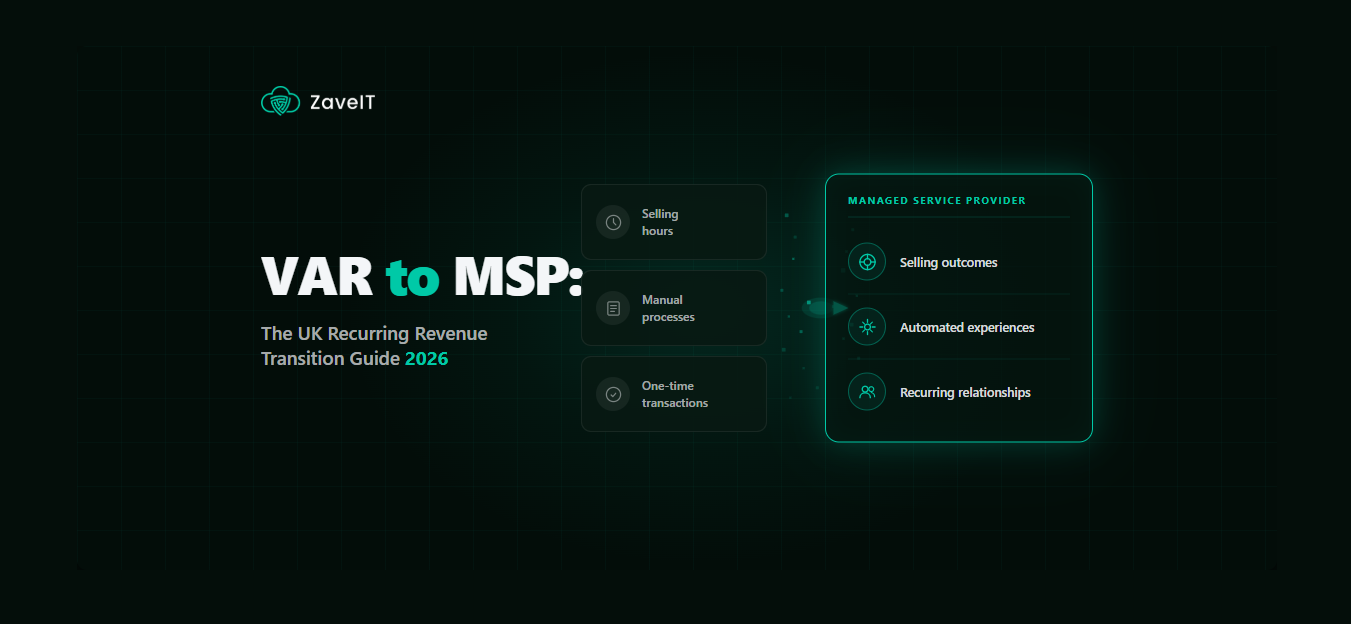
For years, the traditional IT reseller model was straightforward.
A customer needed laptops, servers, licences, networking equipment or software. The reseller sourced it, added a margin, delivered it and moved on to the next opportunity.
That model still has a place. But it is becoming harder to build a predictable growth business around transactions alone.
Customers are buying more technology as subscriptions. Cloud services sit at the centre of day-to-day operations. Cybersecurity needs continuous attention rather than an occasional product purchase. Software licences renew every month or year. And customers increasingly need somebody to manage the growing collection of technology they already own.
For UK value-added resellers (VARs), this creates a natural opportunity: move from primarily selling IT products to building managed services and recurring revenue alongside them.
That does not mean abandoning hardware or becoming a completely different company overnight.
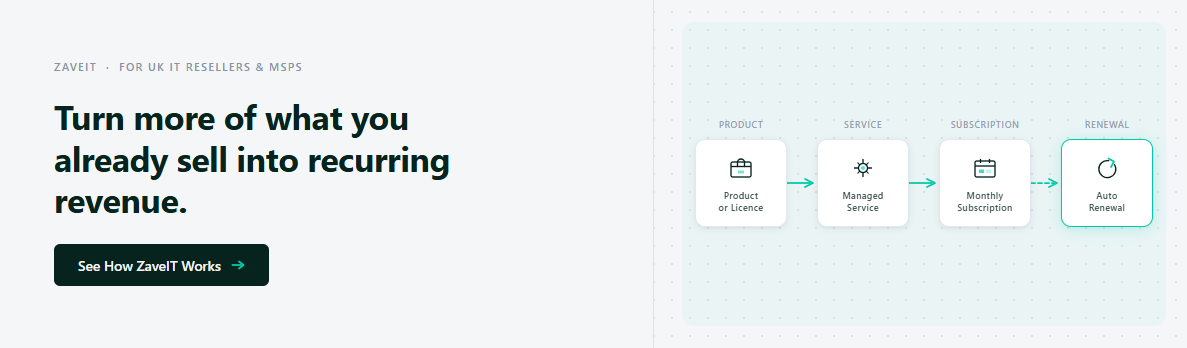
The stronger route is usually a gradual one: product → product plus service → managed service → recurring customer relationship.
Here is how to make that transition without turning the business upside down.
Why the VAR-to-MSP conversation matters in 2026
The UK market gives IT resellers a sizeable base to serve.
At the start of 2025, the UK had an estimated 5.7 million private-sector businesses, according to the Department for Business and Trade. Around 99.85% were SMEs, while SMEs accounted for 60% of private-sector employment and an estimated 51% of turnover.
These businesses are also becoming increasingly dependent on technology.
The UK Business Data Survey 2026 found that 86% of businesses reported handling digitised data of some kind in 2025/26. Meanwhile, the UK government's Cloud Challenge Book states that around 60% of UK businesses use cloud services and describes the UK as one of Europe's largest cloud markets.
For a VAR, that changes the customer conversation.
Selling Microsoft 365 licences, endpoints, networking equipment or cloud subscriptions can be the beginning of the relationship rather than the end of the sale.
Every product creates an operational requirement.
Who manages it?
Who monitors it?
Who protects it?
Who renews it?
Who supports the customer when something goes wrong?
That is where recurring services begin.
VAR vs MSP: what actually changes?
The difference is not simply that an MSP sends monthly invoices.
A traditional VAR is largely organised around transactions. The customer buys something, the reseller fulfils the requirement and revenue is recognised around that sale.
An MSP is organised around an ongoing outcome.
The customer is not simply purchasing a security product, for example. They may be buying managed endpoint protection, monitoring, response and reporting as one recurring service.
Instead of selling backup software, the provider can sell managed backup.
Instead of selling Microsoft licences, it can combine licences with administration, user support and security.
Instead of installing infrastructure and waiting for the next project, it can provide continuous management.
That changes the commercial engine.
Transactional model:
Opportunity → Quote → Product → Delivery → Invoice → Find the next sale
Recurring model:
Customer → Service → Subscription → Delivery → Support → Renewal → Expansion
The second model gives the provider more opportunities to remain relevant after the initial transaction.
But it also creates a new responsibility: the service has to work commercially and operationally every month.
Why recurring revenue is attractive and where VARs get it wrong
The appeal is easy to understand.
If £20,000 of revenue has to be won again every month through separate transactions, the sales team effectively starts each period with a large gap to fill.
If part of that revenue comes from existing managed-service agreements, the commercial position is different.
You begin the month with contracted customer relationships already in place.
That can improve revenue visibility and make account planning easier. It can also shift sales conversations away from individual SKUs towards broader customer needs.
But recurring revenue is not automatically good revenue.
A badly designed managed service can generate monthly invoices while quietly consuming engineering hours, account-management time and administrative effort.
Consider a £1,000-per-month service.
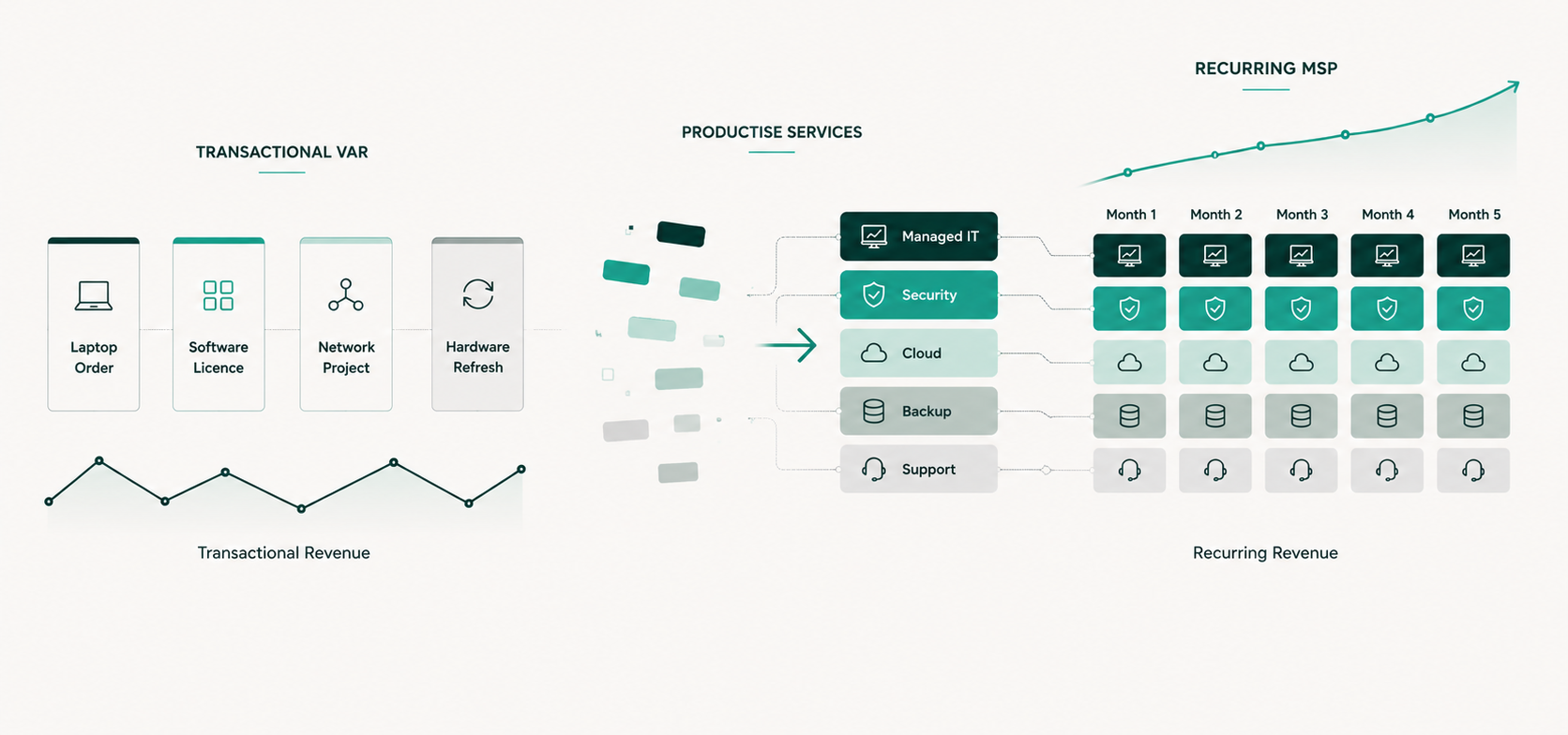
If one customer requires two hours of support and another requires twelve hours for exactly the same package, the revenue may look identical while the economics are completely different.
That is why the transition from VAR to MSP is fundamentally a standardisation exercise, not simply a billing exercise.
Step 1: Start with customers you already understand
The easiest managed service to sell is rarely a completely new idea.
Look at what customers already buy from you and what happens after those purchases.
Suppose you regularly sell:
- Microsoft 365
- laptops and endpoints
- networking equipment
- backup solutions
- cybersecurity products
- cloud infrastructure
Now examine the work surrounding those products.
Customers may already call you to configure accounts, add users, investigate security alerts, manage licences, troubleshoot devices, restore data or renew subscriptions.
If that work happens regularly but is billed inconsistently or sometimes not billed at all you may already be providing the beginnings of a managed service.
The first opportunity is to identify those repeated activities and turn them into a defined offer.
Step 2: Productise the service before trying to scale it
One of the biggest mistakes in the transition is continuing to treat every customer as a completely new project.
Customer A gets one combination of tools.
Customer B gets another.
Customer C receives a special price.
Customer D has an old support arrangement nobody wants to change.
Soon the MSP has recurring revenue but very little repeatability.
A scalable managed service needs boundaries.
For each service, define:
What is included?
Be specific about technology, support and activities.
What is excluded?
Unlimited ambiguity eventually becomes unlimited work.
How is it priced?
Per user, per device, per site, per workload, fixed monthly fee or another clearly understood unit.
How is it delivered?
Document the operational workflow rather than relying on one engineer knowing what happens next.
What service level applies?
Customers need to know what they can expect.
What happens when the customer grows?
A good commercial model should accommodate additional users, devices, locations or services without requiring the contract to be rebuilt.
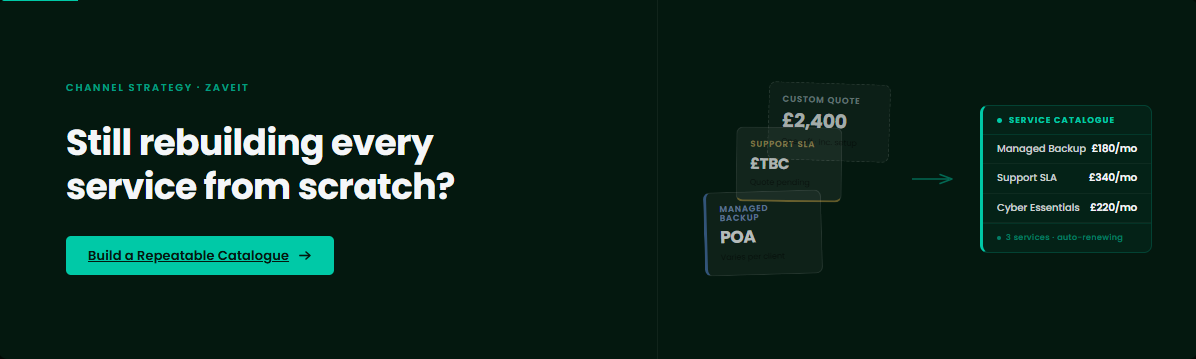
This is your service catalogue.
It should become the commercial source of truth for sales, delivery and the customer.
Step 3: Build packages customers can understand
Customers rarely want to decode your internal technology stack.
They want to understand what they are buying.
That is why packaging matters.
Instead of presenting twelve individual security tools, a VAR moving towards managed services could create packages such as:
Essential IT
Core licences, device management, patching and remote support.
Secure IT
Everything in Essential, plus endpoint protection, email security, backup and security monitoring.
Complete Managed IT
Everything above, combined with broader support, reporting, lifecycle management and agreed service levels.
The exact package structure will vary by customer segment.
The principle does not.
Sell an understandable service rather than a collection of disconnected SKUs.
You can still maintain the detailed technical components internally. The customer-facing offer should explain the outcome, scope, price and service level clearly.
Step 4: Price for delivery, not just procurement
VAR pricing habits can become dangerous when carried directly into managed services.
With products, the calculation may begin with:
buying price + margin = selling price
A managed service has more moving parts.
You need to consider:
- licensing and supplier costs
- expected support effort
- engineering capacity
- onboarding
- account management
- service management
- tooling
- administration
- billing overhead
- escalation risk
- target gross margin
That does not mean customers need to see every internal cost.
It means you need to understand them.
Before launching a recurring service, model what happens when you have 10 customers, 50 customers and 200 customers using it.
If delivery effort rises almost one-for-one with customer numbers, you have created recurring work rather than a scalable recurring service.
Step 5: Make cybersecurity part of the recurring conversation
Cybersecurity provides a particularly clear example of why customers need ongoing services.
The UK Government's Cyber Security Breaches Survey 2025/26 found that 43% of businesses identified a cyber breach or attack during the previous 12 months. The figure rose to 65% among medium businesses and 69% among large businesses. Phishing remained the most common type identified.
That makes security difficult to treat as a one-off installation.
A firewall purchase is a transaction.
Managed security is continuous.
Endpoint monitoring, patching, identity management, backup verification, security awareness, vulnerability management and incident response all lend themselves to an ongoing service relationship.
For an established VAR, the advantage is that you may already have the customer relationship and much of the underlying product knowledge.
The opportunity is to build a service around it.
Step 6: Stop rebuilding every quote
The move to recurring services exposes inefficient sales processes very quickly.
A salesperson copies an old proposal.
Someone checks distributor pricing.
An engineer confirms the technical scope.
Finance checks the margin.
Another person creates the agreement.
Operations receives the order.
Billing manually creates the recurring line item.
That might survive at ten managed-service customers.
At 100, it becomes expensive.
Once your services are standardised, quoting should become repeatable too.
A salesperson should be able to select an approved service, apply the correct customer or pricing rules, generate the quote and move the accepted order into delivery without recreating the commercial structure every time.
This is an important point in the VAR-to-MSP journey:
standardised services should create standardised sales processes.
Otherwise you have improved the product but left the surrounding business untouched.
Step 7: Connect sales to delivery and billing
Recurring revenue becomes much harder to manage when every department works from a different version of the customer agreement.
Sales has the quote.
Operations has a spreadsheet.
Engineering has the ticket.
Finance has the billing system.
The account manager has notes in the CRM.
Nobody is necessarily wrong, but nobody has the whole picture.
The goal should be a connected commercial flow:
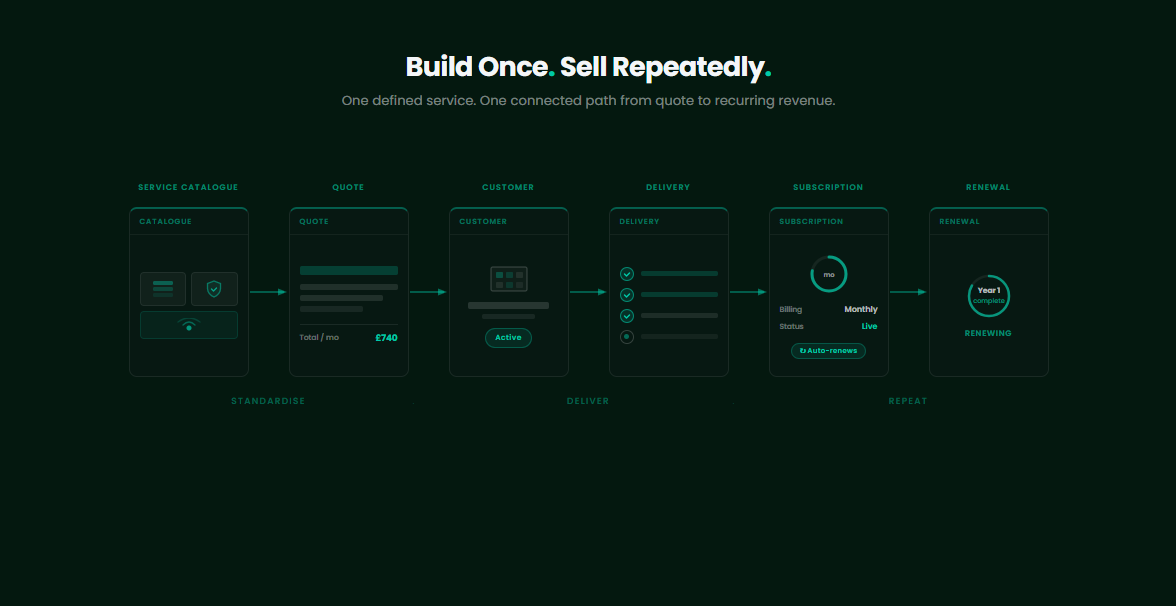
Service Catalogue → Quote → Agreement → Order → Delivery → Subscription → Renewal
When the customer accepts a service, the relevant information should move forward without being manually reconstructed at every stage.
This is where automation becomes important.
Not because every human action should disappear, but because people should not spend their time repeatedly copying information between systems.
Step 8: Give customers more control
Moving towards managed services should not mean forcing customers to contact their account manager for every small change.
A good recurring relationship combines advice with self-service.
Customers should be able to see what they have, understand available services, request additions, access relevant documentation and follow orders or subscriptions without endless email chains.
That expectation fits the wider direction of UK SME digital adoption.
Research commissioned by the Department for Business and Trade found that SMEs place value on reliable, personalised support when adopting technology.
The lesson for MSPs is useful: digital self-service does not replace the relationship.
It removes friction around the relationship.
Your specialists can spend their time advising customers instead of answering questions such as, “Which licences do we currently have?”
Step 9: Measure the business differently
If you have historically operated as a VAR, revenue may have been the headline number.
As recurring services become more important, you need a wider scorecard.
Track metrics such as:
- Monthly Recurring Revenue (MRR)
- Annual Recurring Revenue (ARR)
- gross margin by service
- recurring revenue as a percentage of total revenue
- customer retention
- expansion revenue
- service utilisation
- support effort per customer
- onboarding cost and time
- contract renewal rate
Most importantly, look beneath company-wide averages.
One managed service might have healthy margins while another consumes too much manual effort.
One customer segment might be highly profitable while another constantly requires exceptions.
You need to know the difference.
Step 10: Transition customers rather than forcing them
Your existing customers do not need to wake up one Monday morning and discover that their trusted VAR has suddenly become something else.
Start with the problem.
When a customer renews a licence, ask whether they also want it managed.
When replacing endpoints, introduce device management and support.
When selling backup, discuss recovery monitoring.
When delivering cybersecurity technology, explain the ongoing operational requirement.
The managed service becomes the logical next step rather than a completely separate sale.
This approach also protects the parts of the VAR model that still work.
Hardware, software and projects do not have to disappear.
They can become entry points into longer-term relationships.
What should the transition look like?
You do not need twenty managed services on day one.
Start smaller.
Choose two or three areas where you already have:
- customer demand,
- technical capability,
- supplier relationships, and
- repeatable delivery.
Define the offer.
Calculate the economics.
Document delivery.
Set the price.
Put it into a structured service catalogue.
Train sales.
Pilot it with existing customers.
Then measure what actually happens.
Once the service works consistently, automate more of the surrounding commercial and delivery process and expand the catalogue.
The order matters.
Standardise first. Automate second. Scale third.
Automating a messy process simply allows the mess to move faster.
The VAR does not have to disappear
The VAR-to-MSP transition is sometimes presented as if one business model has to replace the other.
That is unnecessarily restrictive.
There is still value in product expertise, procurement relationships, hardware fulfilment and project work.
The opportunity is to place recurring services around those strengths.
A customer buys laptops from you.
You manage them.
They buy Microsoft licenses from you.
You administer them.
You supply backup.
You manage recovery.
You provide security technology.
You monitor it.
The transaction creates the installed base.
The service creates the ongoing relationship.
That is a far more natural transition than trying to build an MSP from scratch.
From reseller to recurring service business
The biggest change in becoming an MSP is not what appears on the invoice.
It is how the business operates.
You move from selling something once to designing something you can sell, deliver, bill and support repeatedly.
That requires clearer services, consistent pricing, controlled delivery and far less dependence on spreadsheets, inboxes and individual knowledge.
And that is where many VARs discover the real challenge.
They already have customers.
They already have vendor relationships.
They already understand the technology.
What they often lack is the commercial structure that connects products, managed services, quoting, ordering, delivery and subscriptions.
ZaveIT helps MSPs and IT resellers build that structure. Create a repeatable service catalogue, package and price managed services, connect quoting to delivery and subscriptions, and give customers a branded self-service buying experience from one platform.
If your next stage of growth depends on earning more from the customers you already serve rather than starting every month from zero it may be time to turn more of what you sell into services customers keep buying.
Ready to build recurring revenue around your existing IT business?
See how ZaveIT helps IT resellers move towards scalable managed services