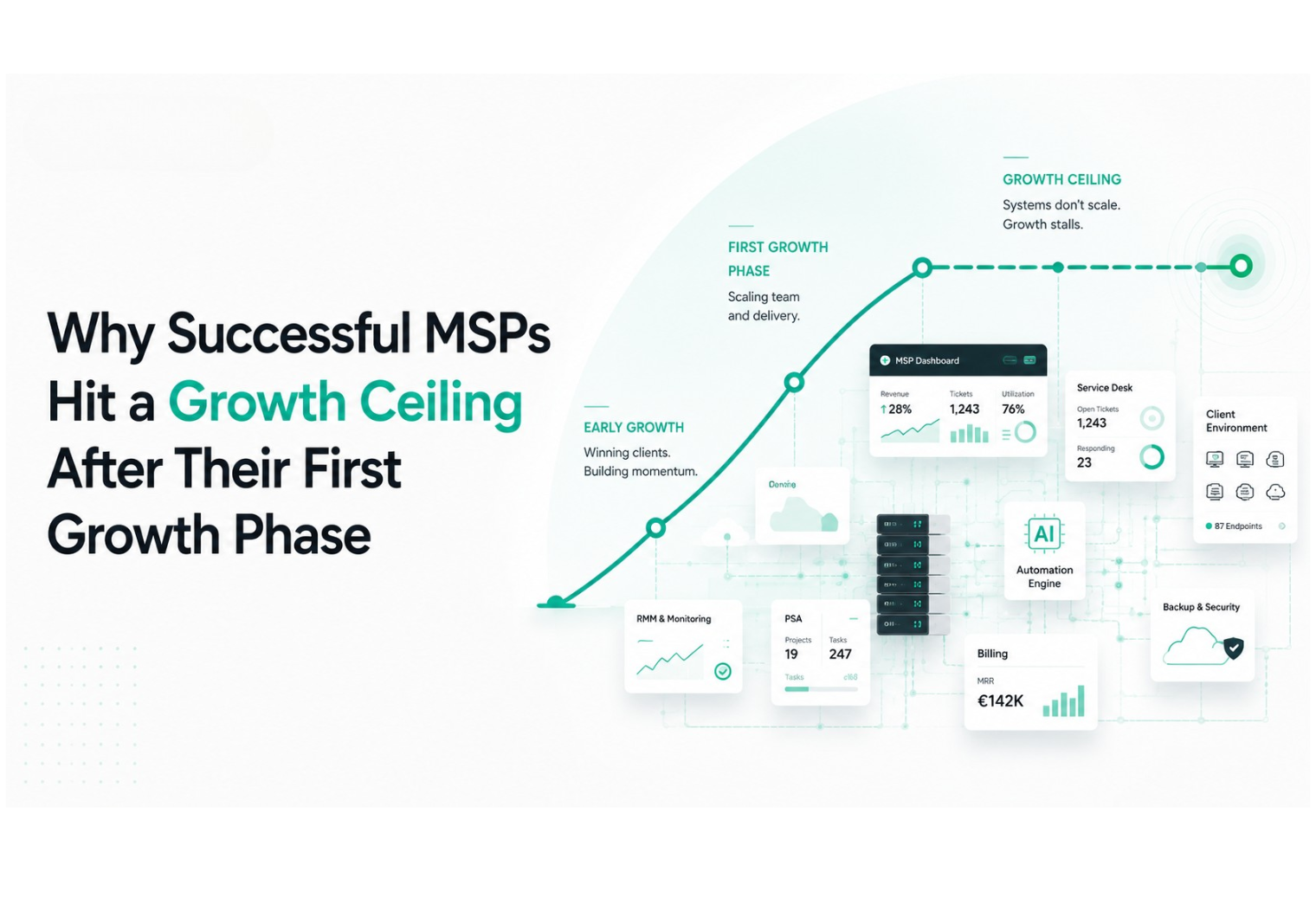
Why Successful MSPs Hit a Growth Ceiling After Their First Growth Phase
There's a pattern in the IT channel that almost nobody says out loud: the habits that carry an MSP to its first $1–2 million in revenue are the same habits that stop it from getting any further. And it's rarely a demand problem. The global managed services market passed $400 billion in 2025 and is forecast to keep compounding at close to 10% a year through the early 2030s, according to Grand View Research. The buyers exist. The ceiling gets built inside the business, one manual workaround at a time.
So what is the MSP growth ceiling? It's the point where a managed service provider's revenue flattens because quoting, ordering, billing, and delivery still depend on manual effort and founder involvement. Past that point, every new customer adds cost and workload faster than it adds profit, so growth stalls even while sales keep closing.
If you own or run an MSP or an IT reseller and this year feels heavier than last year despite a bigger customer list, you've probably hit it. The useful news is that the ceiling is a process problem, not a market problem. Process problems can be fixed.
The First Growth Phase Rewards Exactly the Wrong Habits
Phase one growth is glorious and messy. The founder sells, scopes, prices, and often delivers. Every deal is bespoke, because saying yes to whatever the customer asks is how you win your first 30 logos. Quotes live in Word. Pricing lives in someone's head. Billing is a monthly spreadsheet ritual that one heroic person completes at 11 pm on the 28th.
Here's the thing: at that stage, this is correct behaviour. Speed and flexibility beat process when you're small. Nobody needs a service catalog for eight customers.
The trouble is that success stores up debt. Thirty custom deals become thirty custom contracts, thirty billing arrangements, and thirty slightly different delivery patterns. By the time you pass 100 customers, the operation looks like a house built entirely with hand tools: charming, structurally questionable, and impossible to extend unless the original carpenter is on site.
The 2025 Global MSP Benchmark Report from Kaseya found the same tension across thousands of providers. The MSPs that scale are the ones that cut manual tasks and eliminate what the report calls the “swivel chair”: staff re-keying the same data between disconnected systems. Around 95% of surveyed MSPs said connecting their core tools is essential to running scalable operations, yet most have only automated the technical side of the house. Monitoring and ticketing were solved years ago. Quoting, ordering, invoicing, and renewals were not.
That imbalance is the first growth phase in a nutshell. You industrialised service delivery and left the commercial engine hand-cranked.
What the MSP Growth Ceiling Looks Like in the Numbers
The industry data on this is blunt.
Service Leadership, which has benchmarked solution-provider financials for more than 20 years, reported average adjusted EBITDA for MSPs worldwide at 11.1% in Q4 2024. Best-in-class providers held 19% or better for the fifth consecutive year. Same market, same vendors, same tools available to everyone, and roughly double the profitability.
The same research draws a straight line from process maturity to profit. Providers at Operational Maturity Level-2016-Service-Leadership.pdf) 4 or 5 typically deliver around three times the EBITDA percentage of median-maturity firms, while providers stuck at Level 1 or 2 hover near 0.6% after adjusting for fair owner compensation. Read that again. Not 6%. 0.6%.
There's a second signal hiding in the same dataset: Service Leadership's Q4 index noted that managed service revenue growth is slowing across the industry even while profitability sits near historic highs. The market is rewarding providers who run efficiently and quietly squeezing the ones still growing on heroics.
Datto's State of the MSP Industry 2025 report completes the picture. Tighter margins, rising client expectations, and heavier competition are forcing providers to find structurally cheaper ways to operate rather than simply adding people.
None of these numbers describes a technology gap. Top-quartile and bottom-quartile MSPs buy the same RMM, the same PSA, the same security stack. The gap is commercial: how services get packaged, priced, sold, delivered, billed, and renewed. That's also why the ceiling surprises so many capable operators. They keep improving the part of the business that was already good.
There's a valuation angle here too, and owner-operators feel it hardest at exit. Acquirers of MSPs pay for recurring revenue and transferable process, not for founder relationships. A provider whose commercial engine runs without its owner commands a meaningfully higher multiple than one where the pricing logic and the top ten customer relationships would walk out of the door with a single person. The ceiling doesn't just cap this year's profit. It caps what the business is worth.
Five Bottlenecks That Quietly Cap MSP Growth
From the inside, a growth ceiling feels mysterious. Everyone is busy, customers are mostly happy, and yet the numbers refuse to move. From the outside, it's usually the same five blockages.
1. Quote-to-cash runs on email and memory. A deal travels from a conversation to a Word quote to a PDF to a manually created invoice, with a human ferrying it between every stage. Each handoff adds delay and a chance to get something wrong. When your sales process depends on someone remembering, it caps out at the size of that person's memory.
2. The service catalog lives in your engineers' heads. Ask three people in your company what's included in “Managed Workplace” and you'll collect three different answers. Without productised, versioned service definitions, every sale reopens the scoping debate and every delivery is a small act of improvisation. Improvisation doesn't scale. It also doesn't survive staff turnover.
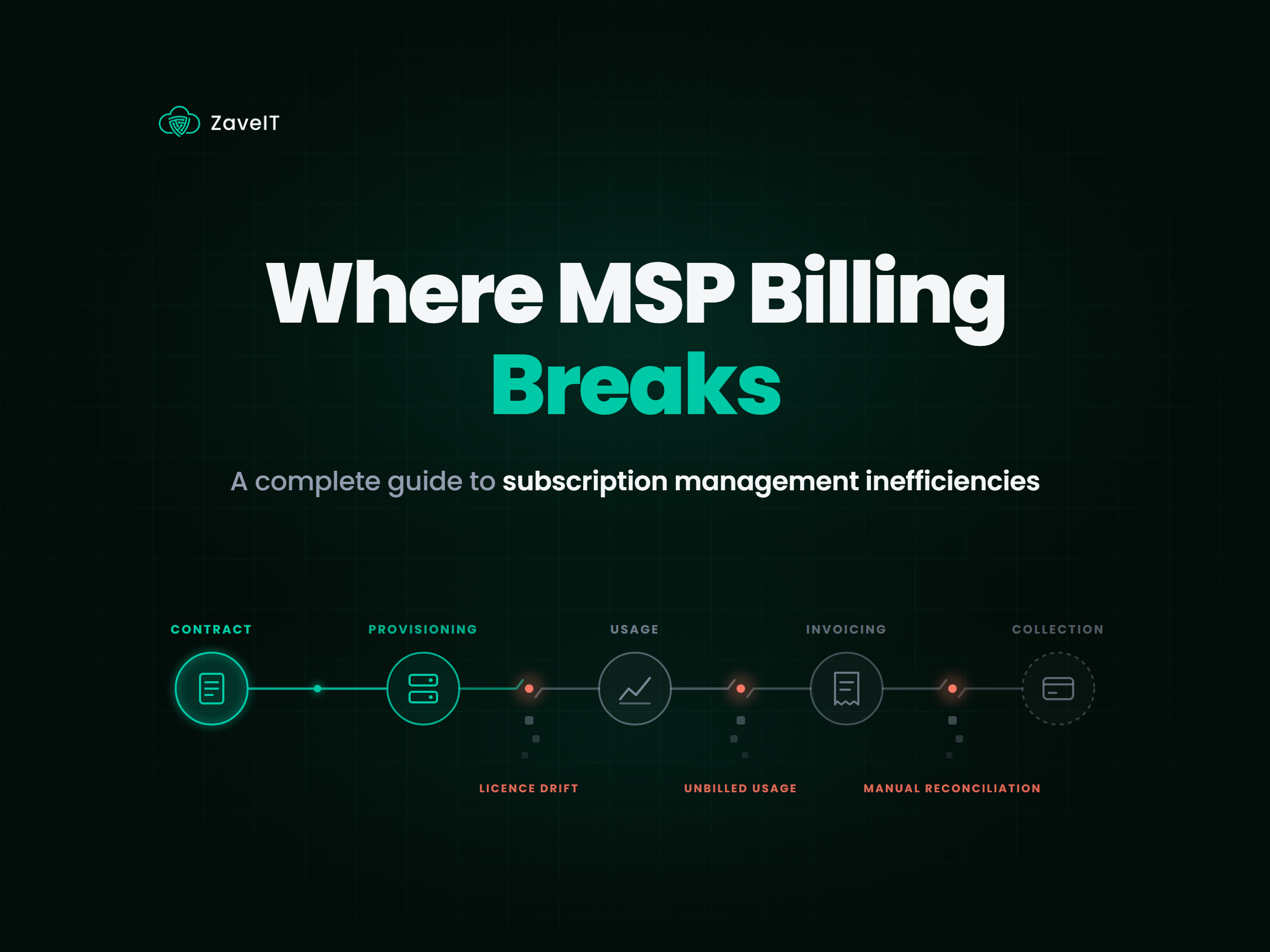
3. Billing leaks margin every single month. Licences provisioned but never invoiced. Usage that drifted above the contracted tier six months ago. Renewals that lapse because no system owned the date. Manual billing doesn't just burn admin hours, it silently gives away money you already earned. At an industry-average 11% EBITDA, there isn't much to give.
4. Everything still routes through the owner. Pricing exceptions, large quotes, escalations, renewals, hiring. Founder judgement was the growth engine of phase one. In phase two it becomes a single-threaded processor that every workflow queues behind. If you can't take a two-week holiday without revenue slowing, your business has a ceiling set exactly at the edge of your calendar.
5. Customers can't buy from you without talking to you. IT buyers order, upgrade, and download invoices themselves everywhere else in their lives. If adding five licences requires an email thread and a three-day wait, you're not only creating friction. You're leaving expansion revenue uncollected, because plenty of customers won't bother asking.
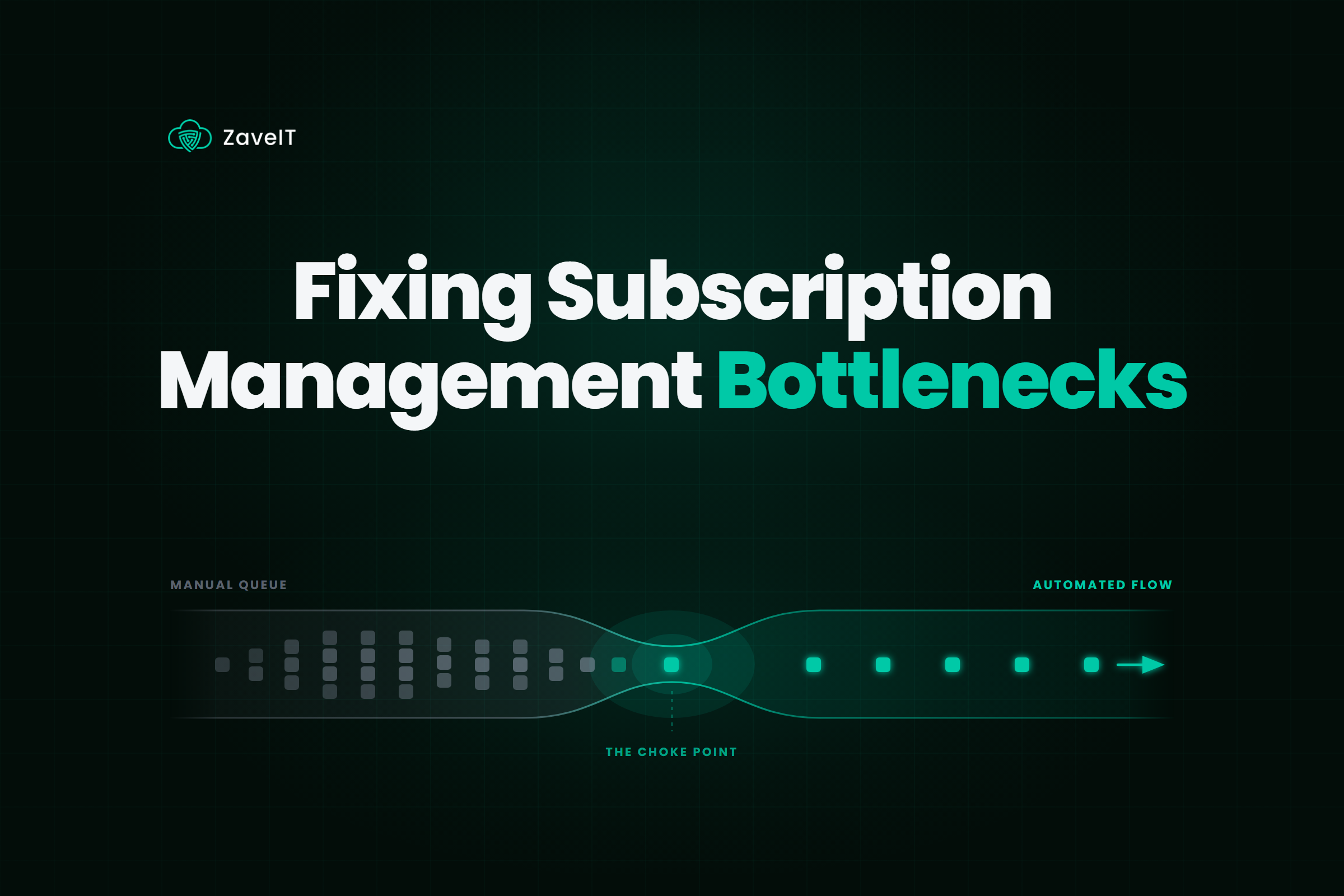
Most stalled MSPs have all five. They compound. A fuzzy catalog makes quoting slow, slow quoting pushes deals to the owner, owner bottlenecks delay billing, and manual billing leaks the margin that would have funded the fix.
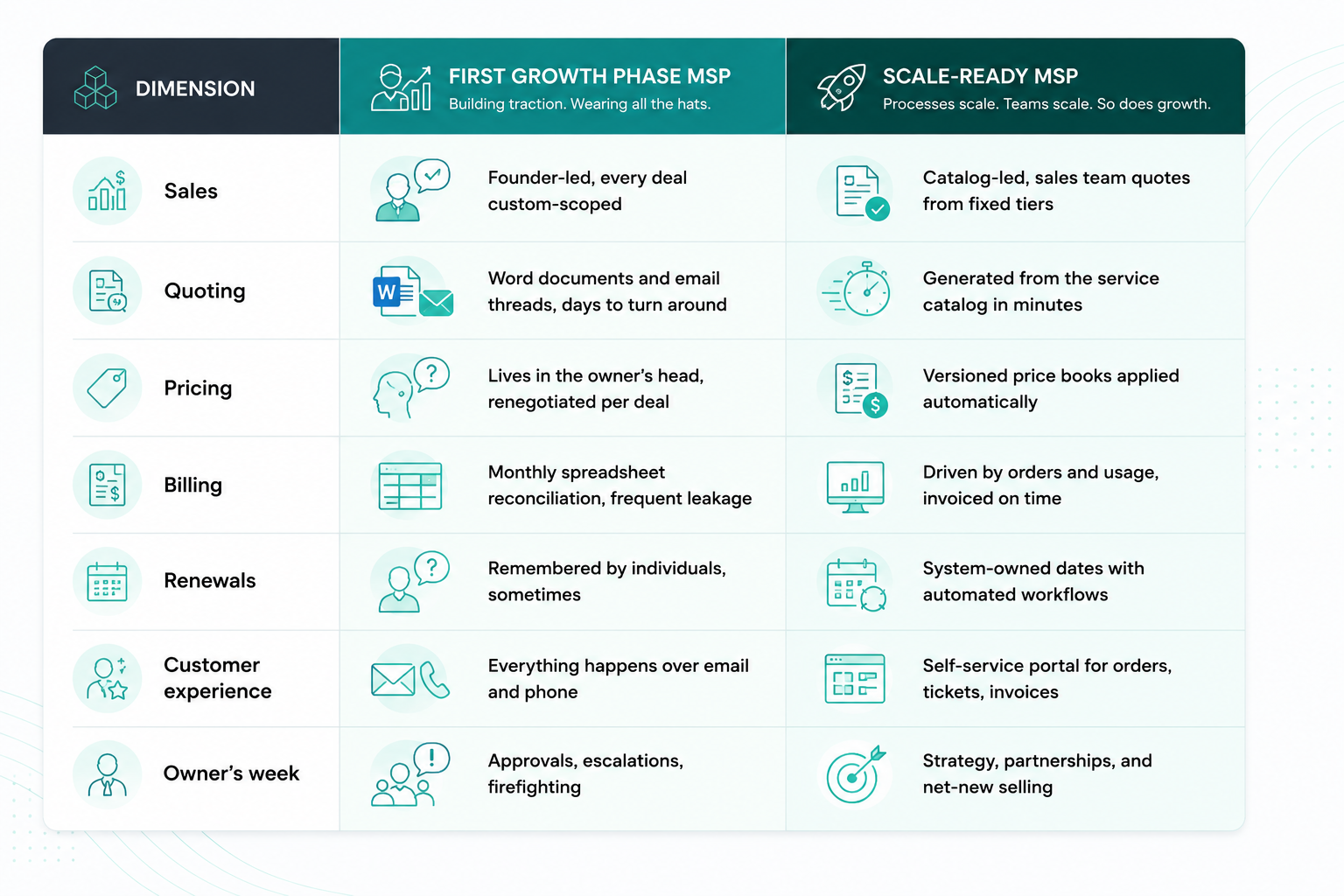
Phase-One Habits vs Scale-Ready Operations: A Side-by-Side
The difference between a provider that stalls and one that keeps compounding shows up in day-to-day operating habits long before it shows up in the accounts. Put the two side by side and the pattern is hard to miss.
Nothing in the right-hand column requires a bigger team. Every line is a process decision, which is exactly why mid-sized MSPs can make the jump without mid-sized budgets. The column you operate in today predicts your margin three years from now better than your headcount, your vertical, or your geography does.
Hiring More People Is the Most Expensive Way to Not Fix This
The instinctive response to operational strain is a job advert. It's also the response that hard-wires the ceiling in place.
The math is unforgiving. When commercial processes are manual, revenue scales linearly with headcount, because each coordinator, admin, or account manager can support only a fixed slice of customers. Salaries rise in step with revenue while coordination costs rise faster than either. You end up bigger, busier, and no more profitable. The channel is full of $5 million MSPs earning less real profit than disciplined $2 million ones.
Frankly, hiring into a broken process just makes the broken process run at higher volume.
There's a second-order cost as well. Every additional coordinator adds handoffs, and handoffs are where errors and delays live. Ten people passing work between inboxes generate more coordination overhead than the customers they serve generate margin, which is how growing MSPs manage the strange trick of getting slower as they get bigger.
Providers that break through invert the order: fix the process first, then hire into a machine that multiplies each person instead of consuming them. That's precisely the difference the operational maturity data measures, and it's worth restating. The top maturity levels earn roughly triple the margin of the middle, in identical market conditions, largely because their commercial operations run themselves.
How MSPs Break Through: Productise, Automate, Self-Serve
Breaking the ceiling isn't one heroic project. It's three connected moves, and the order matters.
Productise the offer. Collapse the 30 custom variations of what you sell into a defined service catalog: named services, fixed tiers, explicit inclusions, versioned prices. Think of it as sharpening the knife before the dinner rush; it feels slow and unglamorous, and it changes everything downstream. A defined product can be quoted, ordered, delivered, and billed without a meeting. A bespoke one can't.
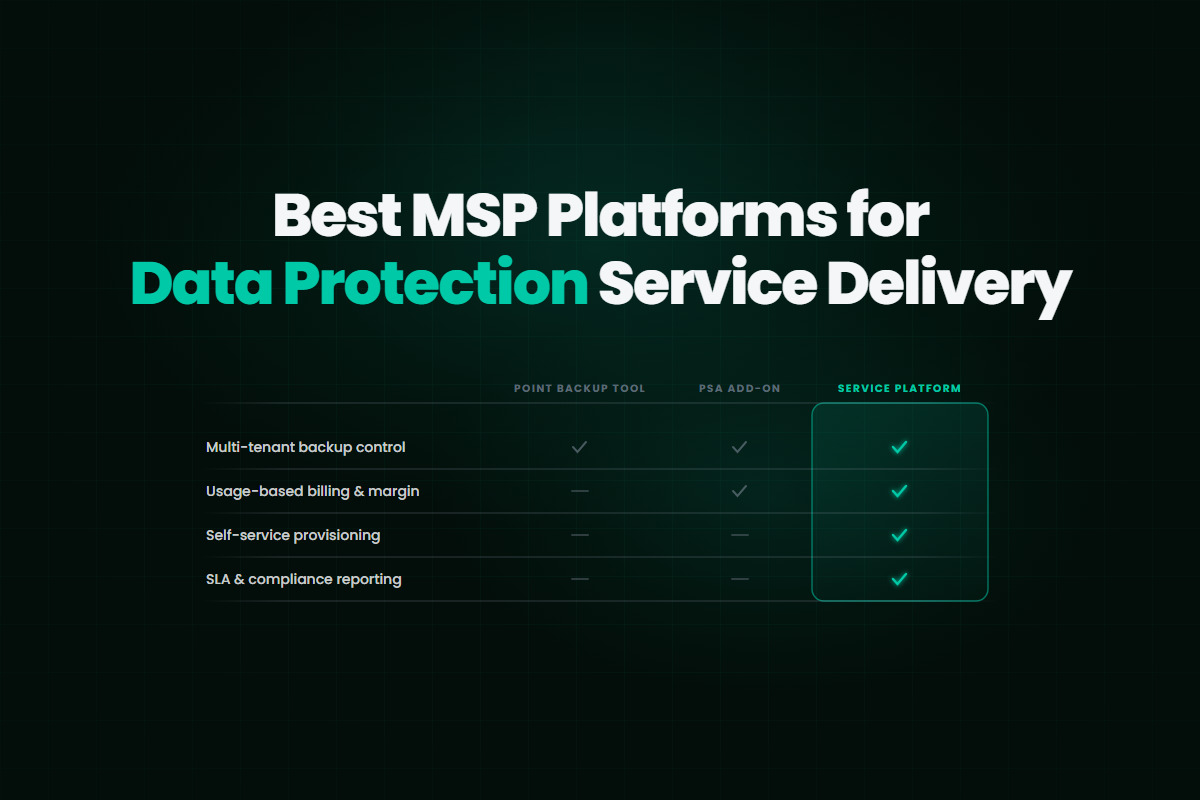
Automate the commercial middle. Connect the flow from packaged offer to order, delivery, invoice, and renewal, so data entered once travels the whole chain. This is the layer most MSP stacks are missing. RMM and PSA platforms industrialized operations years ago, while the commercial layer stayed manual. Purpose-built platforms now close that gap; ZaveIT Core, for example, connects the catalog, quoting, ordering, delivery tracking, and billing in one flow, with integrations into ERPs, CRMs, and distributor feeds so nothing gets re-keyed.
Let customers and partners serve themselves. A white-labelled customer portal where clients browse your catalog, order upgrades, open tickets, and check invoices removes your team from transactions that never needed a human. The same logic extends up the chain: a partner portal lets resellers sell your packaged services without you re-keying their orders, which is how single MSPs quietly turn into multi-tier businesses. Self-service isn't a cost-cutting trick; it's how expansion revenue starts arriving while you sleep.
In my view, the sequencing matters more than the tooling. Productise before you automate, or you'll automate chaos. Automate before you open self-service, or the portal will make promises your back office can't keep. Get the order right and each move funds the next: cleaner billing recovers leaked margin, recovered margin pays for automation, and automation frees the founder to actually sell.
A Gut Check You Can Run This Week
Skip the strategy offsite. Run four checks instead:
1. Trace one deal end to end. Count every manual touch between the first quote and the first invoice. More than five means you've found your ceiling.
2. Ask three employees to define your best-selling service, in writing. Compare the answers.
3. Pull last quarter's licence purchases from your distributor and match them against invoices sent. The gap is margin you already earned and didn't collect.
4. Log every decision that waited on the owner this week, even the small ones.
If the results sting, good. That means your ceiling is made of process, and process can be rebuilt. Providers who connect their commercial flow typically do it in weeks, not quarters, because the services and the customers already exist. What's missing is the machinery between them.
Book a demo with ZaveIT to see how a packaged catalog, automated order-to-invoice flows, and self-service portals would fit your stack, and bring the numbers from those four checks with you. It'll be a far more interesting conversation than another debate about which RMM to buy.