Most MSPs do not wake up one morning and decide:
“We’re going to run our service business from a spreadsheet.”
It happens gradually.
You start with a simple Excel file containing a few services, supplier costs and selling prices.
Then you add another vendor.
Another licence.
A different price for a long-standing customer.
A new managed service package.
A special deal that sales agreed six months ago.
Before long, the spreadsheet is no longer just recording what you sell.
It is helping run how you sell it.
And that is where things can become difficult.
For growing MSPs and IT resellers, the problem is not that Excel is a bad tool. The problem is that a spreadsheet was never designed to become the commercial operating system for a growing portfolio of services, subscriptions, licences, bundles, customers and pricing rules.
The question is therefore not:
“How do we create a better spreadsheet?”
It is:
“How do we turn what we sell into a structured, repeatable service catalogue?”
That distinction matters.
Excel works until the business outgrows it
There is nothing inherently wrong with managing an early service portfolio in Excel.
If you have a small number of services, a small sales team and relatively simple pricing, a spreadsheet may do exactly what you need.
The pressure usually appears as the business grows.
Perhaps your MSP now sells:
- Microsoft 365 or other cloud licences
- managed support packages
- backup and security services
- connectivity
- hardware
- onboarding services
- professional services
- recurring subscriptions
- vendor products
- your own packaged services
Different customers may also have different contract terms, quantities, prices or service combinations.
At this point, keeping information accurate becomes more important and more difficult.
A salesperson needs to know the current price.
Finance needs to know the cost and margin.
Operations need to know exactly what was sold.
The customer needs to understand what is included.
And the person responsible for delivery needs enough information to fulfill the order correctly.
If those answers are spread across spreadsheets, documents, email conversations and individual employees' knowledge, the problem is no longer just administration.
It becomes a scalability problem.
ConnectWise makes a similar point in its guidance for technology service providers. It recommends standardised service offerings and quote content, including standardising scope, pricing, billing methods, roles and responsibilities. Its reasoning is straightforward: fewer variations make services easier to support and help create a more consistent commercial process.

7 signs your MSP has outgrown its service spreadsheet
You may not need to replace Excel simply because you use it.
But there are some clear warning signs that your service catalogue needs more structure.
1. Only one or two people really understand what you sell
Ask someone in sales:
“What exactly is included in this service?”
If the answer is:
“Speak to John he knows how we normally price that.”
you have a problem.
Important commercial knowledge should not exist only in someone's memory.
Customers may still receive the right answer today, but the process becomes harder to repeat as more people join the business.
A structured service catalogue turns that knowledge into something the wider organisation can use.
2. Every proposal starts from scratch
One customer needs to manage Microsoft 365.
Another needs almost the same thing.
Yet sales creates two separate proposals, manually checks licences, adjusts pricing and rewrites the scope each time.
There will always be situations that need tailoring.
But if every sale is treated as a completely new project, your sales process becomes dependent on repeated manual work.
ConnectWise specifically recommends standardising quote content to create consistency around service scope, pricing, billing and responsibilities.
The goal is not to remove flexibility.
It is to stop rebuilding the same offer unnecessarily.
3. Pricing needs to be checked manually before every quote
Imagine a salesperson preparing a quote.
They open the service spreadsheet.
Then another supplier spreadsheet.
Then an email containing the latest vendor pricing.
Then perhaps a previous customer proposal to check what was charged last time.
That is not really a quoting process.
It is information gathering.
And the more places people need to check, the harder it becomes to maintain consistency.
Pricing deserves particular attention because service profitability depends on understanding both the cost of providing a service and the price charged to the customer. Kaseya's MSP pricing guidance similarly highlights the need to consider service costs when choosing pricing models, while ConnectWise recommends keeping product catalogue costs and prices aligned with the organisation's pricing strategy.
Your service catalogue should help make the approved commercial structure clear before the quote is created.
4. Different customers are buying slightly different versions of the same service
This happens easily.
Customer A receives:
Managed Workplace
Customer B receives:
Managed Workplace Plus
Customer C receives something almost identical, but with one additional security product.
Customer D has a package created three years ago that nobody wants to change because nobody is completely sure what is included.
Eventually, what looked like one service became many variations.
Some variation may be necessary.
But uncontrolled variation makes pricing, selling, supporting and improving services harder.
This is one reason standardisation is important to MSP operations. ConnectWise notes that fewer variations across customer environments can improve supportability because teams have fewer variables and exceptions to manage.
5. Sales and delivery interpret the same service differently
Sales believes onboarding is included.
Operations believes it is chargeable.
The customer believes migration is part of the package.
Finance sees a different recurring amount in the contract.
Nobody intentionally created the confusion.
The service simply was not defined clearly enough.
A proper catalogue should give teams a common answer to questions such as:
What is this service?
What does the customer receive?
What is included?
What is excluded?
How is it priced?
How is it delivered?
That shared understanding is often more valuable than simply having a tidy list of products.
6. Updating one service means changing information in several places
A supplier changes the price.
Now someone needs to update:
- the internal spreadsheet
- quote templates
- product documentation
- perhaps a webshop
- perhaps customer-facing information
- perhaps reseller information
This is where disconnected service data creates unnecessary work.
The issue is not that updating information takes a few minutes.
The bigger question is:
How confident are you that every place now shows the same information?
For a growing MSP, a service catalogue should increasingly become a controlled source for the services the business sells rather than another isolated document.
7. Customers cannot easily see what else they can buy from you
This is often overlooked.
Many MSP customer relationships are still highly person-dependent.
A customer wants another licence, security service or backup solution.
So they email their account manager.
The account manager checks availability.
Someone prepares a quote.
The customer approves it.
Operations receive the request.
That approach is perfectly reasonable for complex purchases.
But does every additional service need the same level of human intervention?
Modern MSP platforms increasingly support customer self-service alongside conventional service management. HaloPSA, for example, provides customer self-service portal capabilities as part of its MSP platform.
ZaveIT takes the catalogue further into the commercial journey by connecting services with customer portals, sales channels, ordering and delivery workflows.
For MSPs and IT resellers, that creates an important question:
Could your existing customers discover and buy more from you if your services were easier to understand and access?
A service catalogue is not just a list
This is where many businesses get caught.
They move the spreadsheet into another system and assume the service catalogue problem is solved.
But a digital list is still just a list.
A useful MSP service catalogue should provide structure around how a service is packaged, priced, sold and delivered.
Think about the difference.
A spreadsheet might tell you:
Service: Managed Backup
Supplier: Vendor X
Cost: £X
Price: £Y
Useful information.
But your business may need much more.
A structured catalogue might define:
Managed Backup
→ what the service includes
→ which vendor product sits underneath it
→ eligible devices or users
→ setup charge
→ recurring charge
→ customer selling price
→ service dependencies
→ contract requirements
→ delivery steps
→ sales channel
→ customer documentation
Now you are no longer just documenting a product.
You are defining how the business sells and fulfills it.
That is the real opportunity.
What should an MSP service catalogue contain?
There is no single structure that every MSP must follow.
Your catalogue needs to reflect your own commercial model.
But when reviewing an offering, these are useful questions to answer.
1. What are we selling?
Give the service a clear name.
Avoid internal terminology that only your technical team understands.
A customer should be able to understand the offer without decoding your organisation chart or vendor stack.
2. What problem does it solve?
Customers are rarely excited about your internal product structure.
They care about the outcome.
Instead of starting with:
“This bundle contains Product A + Product B + Product C.”
start with:
“This service protects Microsoft 365 data and provides managed recovery support.”
Technology still matters.
But the customer outcome should be clear first.
3. What is included?
Define the service.
For example:
- licences
- configuration
- monitoring
- support
- maintenance
- reporting
- onboarding
- service reviews
This gives sales and delivery the same reference point.
4. What is not included?
This is just as important.
If migrations, project work, after-hours support or additional devices are outside the package, make that clear.
Good packaging creates clarity before a misunderstanding becomes a commercial discussion.
5. How is it priced?
The catalogue should define the approved pricing model.
Depending on the service, that might be:
- per user
- per device
- per month
- fixed fee
- consumption based
- one-off
- a combination of recurring and one-off charges
MSPs use several pricing models, including per-user and per-device approaches, and service bundles can contain different types of charges depending on the service being provided.
The important part is not choosing one pricing model for everything.
It is making the chosen model clear and repeatable.
6. What does it cost you to deliver?
Selling price alone does not tell you whether an offer works commercially.
You also need visibility into the cost of licences, supplier products, labour or other delivery components.
Kaseya highlights service delivery costs as an input into MSP pricing, while ConnectWise recommends maintaining product catalogue cost information so pricing remains aligned with the provider's commercial strategy.
That makes cost and margin discipline part of catalogue management not something to think about only after a deal has been signed.
7. What happens after the customer buys it?
This question is often missing.
Who gets notified?
What needs provisioning?
Does someone need to order a licence?
Does the service desk need information?
Is onboarding required?
Does finance need to create recurring billing?
When service definition and delivery remain disconnected, a successful sale can simply create more administration.
A scalable catalogue should help connect what was sold with what needs to happen next.
The real shift: from custom services to productised services
This is where service catalogue management becomes commercially interesting.
Many MSPs have strong technical expertise.
But expertise itself is difficult to scale if every customer engagement needs to be designed from scratch.
Productisation means turning that expertise into a clearer, repeatable offer.
Consider a simple example.
Instead of saying:
“We can manage your Microsoft 365 environment and we'll put together something based on your requirements.”
you might create a defined service:
Microsoft 365 Managed Workplace
Designed for:
Businesses that need ongoing administration and support for their Microsoft 365 environment.
Includes:
- Microsoft 365 licence
- initial setup
- user administration
- agreed security configuration
- ongoing support
- defined service level
Pricing:
Defined according to your chosen commercial model.
The exact package will differ from one MSP to another.
That is not the point.
The important change is that your expertise has moved from someone's head into a defined commercial offer.
Sales can understand it.
Customers can understand it.
Operations knows what must be delivered.
Finance knows how it is charged.
And management can decide whether it should be improved, expanded or retired.
That is what productisation makes possible.
What changes when your services become structured?
A proper catalogue can affect more than quoting.
For the owner
The business becomes less dependent on individual knowledge.
You can see more clearly what the company actually sells instead of relying on “how we've always done it”.
For sales
People spend less time reconstructing familiar offers.
They can focus more of the conversation on the customer's problem rather than searching for product information and pricing.
For finance
Pricing, costs and charging models can be managed with greater discipline.
That matters because profitable service growth depends on understanding what a service costs to provide and whether the selling price supports the business model.
For operations
The team receives a clearer definition of what has been sold.
That can reduce the ambiguity that often appears between proposal and delivery.
For customers
Services become easier to understand.
And where appropriate, a customer portal can allow customers to browse or manage services without every interaction beginning with an email or phone call. HaloPSA supports customer self-service within its MSP platform, while ZaveIT connects its service catalogue directly with customer portals and sales channels.
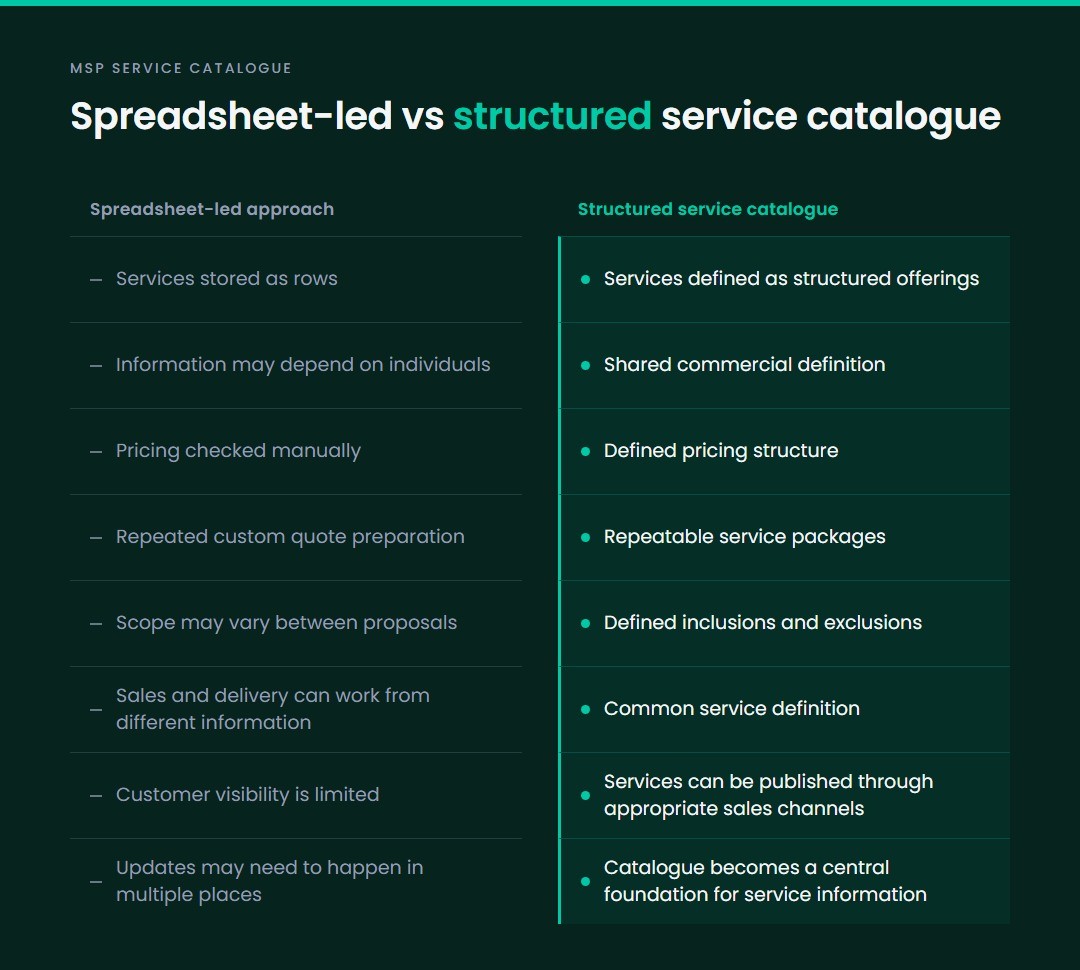
Spreadsheet vs structured service catalogue
The goal is not to eliminate every exception.
Customers will still have different requirements.
Complex solutions will still require consultation.
And some projects should remain bespoke.
The goal is to make repeatable work repeatable.
How to move your MSP service catalogue out of Excel
You do not need to redesign your entire service business in one week.
Start with the services you already sell.
Step 1: Audit your current portfolio
Bring together the services, licences, bundles and recurring offers currently being sold.
You may discover:
- duplicates
- old services
- inconsistent names
- unclear ownership
- customer-specific versions
- prices nobody can explain
That is useful information.
Do not clean it up before the audit.
You need to see the real picture first.
Step 2: Identify your repeatable services
Ask:
Which services do we sell again and again?
Start there.
These are usually better candidates for standardisation than highly specialised projects.
Step 3: Define each service properly
Document:
- customer outcome
- inclusions
- exclusions
- underlying products
- supplier dependencies
- pricing model
- delivery requirements
- contract requirements
If your team cannot agree on what the service includes, that is a useful problem to uncover now rather than during a customer conversation.
Step 4: Standardise where it makes sense
Do not standardise simply for the sake of it.
Standardise the parts of your business where variation creates little customer value.
That might include:
- core service packages
- onboarding charges
- support levels
- standard licences
- recurring add-ons
- delivery steps
ConnectWise's guidance similarly links standardised services with better supportability and quote consistency.
Step 5: Review pricing and costs
For every repeatable service, understand:
What does it cost us?
What do we charge?
What changes the cost?
Who can change the price?
How frequently should the price be reviewed?
Pricing should be treated as part of service design, not just something added at the end of a proposal. ConnectWise specifically recommends regularly maintaining catalogue cost and pricing information as part of pricing strategy.
Step 6: Connect the catalogue to quoting and sales
Your catalogue should make selling easier.
If a service has already been defined, sales should not need to recreate the commercial logic every time it is quoted.
The closer the connection between catalogue and quoting, the easier it becomes to maintain consistency.
Step 7: Connect selling with delivery
Do not stop at quote generation.
Ask:
What happens when the customer says yes?
The order should contain enough structured information for the next team or workflow to know what needs to happen.
This is where catalogue management starts moving beyond sales enablement and into operational scalability.
Step 8: Decide what customers should be able to buy themselves
Not every service is self-service.
A complex infrastructure transformation probably needs a conversation.
Adding another standard licence may not.
Divide your catalogue into:
Services that require consultation and service customers can confidently order themselves.
That can help turn the customer portal from a support-only destination into another commercial channel.
ZaveIT's service catalogue model is built around this connection between structured services, portals, sales channels, ordering and delivery.
Don't just digitise the spreadsheet
This is perhaps the biggest mistake to avoid.
Moving your Excel file into another database does not automatically make your MSP more scalable.
You can have sophisticated software and still maintain:
- unclear services
- inconsistent pricing
- custom proposals
- manual handovers
- undocumented exceptions
Technology cannot fix a service model that has never been defined.
The first job is commercial clarity.
Then technology can help make that clarity repeatable.
Think of the journey like this:
Scattered service knowledge
↓
Clearly defined offerings
↓
Structured service catalogue
↓
Repeatable quoting and selling
↓
Connected ordering and delivery
↓
Easier recurring service growth
That is a very different objective from simply “getting rid of Excel”.
Your spreadsheet is not the real problem
If Excel still works for your business today, there is no reason to replace it simply because someone tells you spreadsheets are outdated.
But if your MSP is growing and you find that services are increasingly difficult to price, quote, explain, update and fulfill consistently, pay attention.
Those are symptoms of a larger issue.
Your commercial model may have outgrown the way your services are being managed.
A structured service catalogue gives you an opportunity to turn years of technical knowledge into something more useful:
Clear services.
Clear packages.
Clear pricing.
Clear delivery.
And, importantly, offers that are easier to sell again.
Because scaling an MSP should not mean rebuilding the same service for every new customer.
It should mean getting better at delivering the services you already know how to deliver well.
Ready to move beyond the spreadsheet?
ZaveIT helps MSPs and IT resellers structure products, licences and managed services into a connected catalogue that can support quoting, sales channels, customer self-service and delivery workflows.
Instead of maintaining another static list, you can build a clearer foundation for how your services are packaged, sold and delivered.
See how ZaveIT can help you build a service catalogue designed for repeatable growth.