Cloud Adoption Has Already Happened. Now MSPs Need to Make It Profitable at Scale.
Why MSPs and IT resellers need a stronger business layer for cloud and managed services
Cloud computing is no longer a new opportunity for Managed Service Providers and IT resellers. It is already part of how modern IT services are bought, delivered and consumed.
Most MSPs and resellers already offer cloud services in some form. They may sell infrastructure, backup, cybersecurity, SaaS, productivity tools, hosting, licensing, managed services or a combination of them all.
The real question is no longer:
Should we offer cloud services?
It is:
How do we package, sell, deliver and manage cloud and managed services profitably at scale?
This shift matters.
For growing MSPs and resellers, cloud has created enormous opportunities. But it has also introduced a new level of complexity. More vendors. More subscriptions. More customer expectations. More service combinations. More portals. More manual processes. More pressure on margins.
Cloud created the opportunity.
Now MSPs and resellers need the structure, automation and customer experience to scale it.
The cloud market is mature. The operating model often is not.
Cloud services have become the foundation of modern IT delivery. Customers expect flexibility, scalability and subscription-based services. They expect fast access, clear pricing, simple ordering and ongoing visibility.
For MSPs and resellers, this creates a major opportunity.
But it also creates a more demanding market.
When cloud becomes mainstream, simply offering cloud services is no longer enough to stand out. Customers already expect them. Competitors already provide them. Vendors already enable them.
The differentiator moves elsewhere.
It moves to how well an MSP or reseller can:
- structure services clearly
- create repeatable offerings
- present services in a professional way
- make it easy for customers to buy
- automate order and delivery workflows
- manage multiple vendors and service types
- support customer-specific pricing and access
- scale without adding unnecessary manual work
- protect margins as competition increases
This is where many MSPs and resellers are under pressure.
They have grown their cloud business, but the commercial and operational layer around that business has not always kept up.
The real challenge is not access to cloud. It is managing cloud complexity.
Most established MSPs and resellers do not struggle because they lack services to sell. They struggle because those services are difficult to organise, package, sell, deliver and manage efficiently.
A typical provider may work with multiple cloud vendors, distributors, software providers, security platforms, infrastructure partners and internal service teams.
Each service may have different pricing models, delivery steps, renewal processes, customer requirements and support expectations.
The result is often a fragmented operating model.
Sales teams rely on manual quotes and internal knowledge.
Service descriptions vary between customers.
Customers do not always know what they can buy, what they already have or what is included.
Orders move through email, spreadsheets, ticketing systems and vendor portals.
Delivery teams depend on manual handovers.
Partner and reseller structures become difficult to manage consistently.
Upsell opportunities are missed because services are not visible or easy to expand.
Margins are affected by administration, rework and slow delivery.
For smaller providers, these problems are inconvenient.
For growing and mature MSPs, they become structural.
At scale, manual work is not just inefficient. It becomes a growth constraint.
Mature MSPs need to think beyond the service desk
Many MSPs have invested heavily in tools for monitoring, ticketing, remote management, security and support.
These tools are important. But they do not always solve the commercial side of the MSP business.
They do not necessarily answer questions like:
How do we make our services easier to buy?
How do we standardise what we sell across customer segments?
How do we present cloud and managed services in a clear customer-facing catalogue?
How do we automate the journey from order to delivery?
How do we reduce back-and-forth between sales, operations and delivery?
How do we enable customers to self-serve without losing control?
How do we support partner or reseller channels with the same structured catalogue?
This is the gap many MSPs and resellers now need to close.
They do not only need better technical operations.
They need a stronger business layer.
What is a business layer for MSPs and resellers?
A business layer is the connected structure between the services a provider offers and the way those services are sold, ordered, delivered and managed.
It connects the commercial experience with the operational reality.
For an MSP or reseller, that business layer should include:
- a structured service catalogue
- customer-specific product and service availability
- clear bundles and service packages
- customer portals or digital buying channels
- order handling
- delivery workflows
- automation
- integrations with existing systems
- partner and reseller structures
- visibility across customers, services and orders
This layer becomes increasingly important as the business grows.
Without it, the organisation becomes dependent on people remembering processes, manually updating systems and coordinating work across fragmented tools.
That may work for a small team.
It does not scale well across larger customer bases, multiple departments, several locations or partner-led business models.
Customer experience is now part of the service
Business buyers are still people.
They are used to simple digital buying experiences in their private lives, and they increasingly expect the same clarity and convenience at work.
For MSP and reseller customers, that means they want to:
- understand what services are available
- order products and services digitally
- see what they already have
- track delivery progress
- access support and invoices
- manage licences and subscriptions
- receive a professional and transparent experience
This does not mean relationships are becoming less important.
It means the relationship needs better digital support.
Customers still value expertise, advice and trust. But they also expect speed, transparency and control.
If two providers offer similar cloud, security or managed services, the easier provider to buy from, work with and grow with may have the advantage.
In other words, customer experience is no longer separate from the service.
It is part of the service.
The margin challenge: growth does not always mean profitability
Cloud and managed services are attractive because they can create recurring revenue.
But recurring revenue does not automatically mean strong margins.
As MSPs and resellers grow, they often face margin pressure from:
- manual provisioning
- complex vendor management
- fragmented systems
- customer-specific exceptions
- unclear service ownership
- support-heavy onboarding
- poor visibility into active services
- low automation between order and delivery
The result is that revenue grows, but operational complexity grows with it.
This is one of the most important challenges for mature providers.
Growth should create leverage.
But if every new customer, service or partner adds more manual administration, the business loses some of that leverage.
That is why automation and structure are not just operational improvements.
They are margin protection.
The opportunity: turn cloud services into scalable service businesses
The next phase of MSP and reseller growth will not be won by simply adding more cloud products.
It will be won by the providers that can turn cloud and managed services into scalable commercial models.
That means moving from:
We can deliver this service.
To:
We have a structured, repeatable and profitable way to sell, deliver and manage this service.
This requires a shift in thinking.
Cloud services should not only sit in vendor portals or internal systems. They should be organised into clear offerings that customers can understand, buy and expand over time.
Managed services should not depend on manual handovers. They should be connected to order and delivery workflows.
Customer portals should not be treated as nice-to-have add-ons. They should become part of the value proposition.
Partner models should not rely on scattered processes. They should be supported by controlled access, structured catalogues and scalable administration.
This is where ZaveIT fits in.
How ZaveIT helps MSPs and resellers scale cloud and managed services
ZaveIT helps MSPs, IT resellers and service providers create the business layer needed to scale cloud and managed services more efficiently.
It connects service catalogues, customer portals, product and service sales, ordering, delivery workflows and partner structures in one platform.
For growing and mature providers, this solves a critical challenge:
How do you grow without adding the same level of operational complexity?
1. Build a structured service catalogue
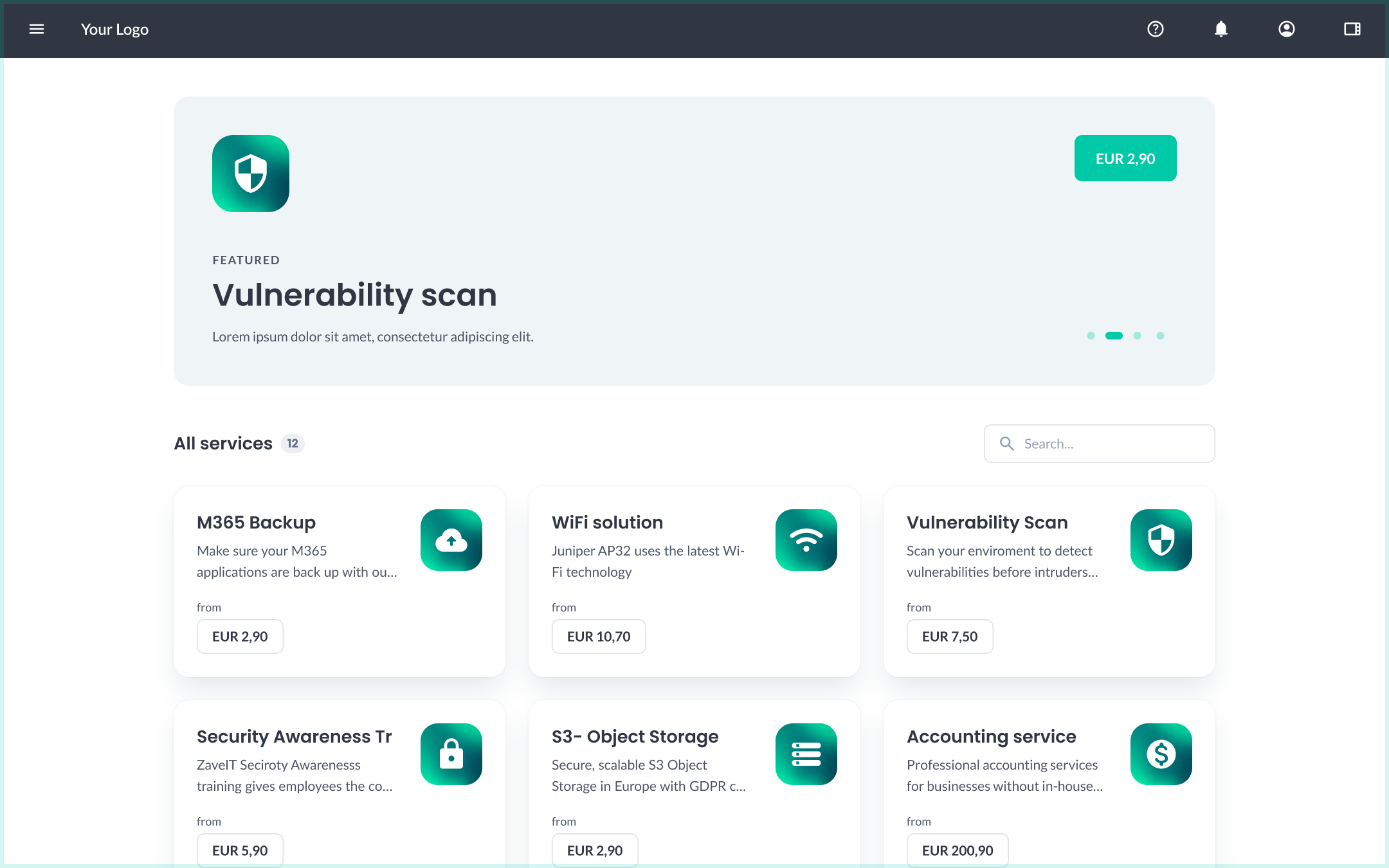
ZaveIT enables MSPs and resellers to organise products, cloud services, managed services and internally developed offerings in a structured catalogue.
This gives the provider a clearer way to package and present services.
Instead of relying on scattered documents, spreadsheets or individual account managers' knowledge, services can be made available in a more consistent and scalable way.
A structured service catalogue also makes it easier to create bundles, define customer-specific availability and support repeatable sales models.
2. Create modern digital sales channels
ZaveIT allows MSPs and resellers to make services available through customer portals, webshops or embedded service catalogues.
This creates a more modern buying experience for customers and makes it easier to support upsell and cross-sell.
For mature providers, this is not about replacing relationships.
It is about making relationships easier to scale.
Customers still value expertise and advice. But they also want transparency, speed and control.
A digital sales channel supports both.
3. Automate order and delivery workflows
Manual work is one of the biggest barriers to MSP scalability.
ZaveIT helps connect ordering and delivery in a more structured flow. This reduces internal friction and makes it easier to standardise how services are delivered.
For larger or growing providers, this can reduce dependency on manual handovers between sales, operations, delivery and support.
The result is a more predictable process for the provider and a better experience for the customer.
4. Improve customer transparency
Customers should not need to send an email to understand what they have bought, what services are active or where a delivery stands.
ZaveIT helps MSPs and resellers offer customers better visibility through a dedicated customer portal.
This can reduce support pressure, improve trust and make it easier for customers to engage with the full service portfolio.
Transparency is not just a customer benefit.
It is also a commercial advantage.
When customers can see more, understand more and access more, they are more likely to expand the relationship.
5. Support partner and reseller growth
Many MSPs and service providers operate through partner networks, reseller channels or multi-level customer structures.
This creates additional complexity.
ZaveIT supports more structured partner and reseller models by enabling providers to manage catalogues, access and service availability across different levels.
This is especially relevant for businesses that want to expand through partners, support multiple brands or scale channel-driven service sales.
Why this is a leadership issue, not just an IT issue
The need for a stronger business layer is not only a technical question.
It is a leadership question.
For MSP and reseller leaders, the key questions are:
Can we scale revenue without scaling manual work at the same pace?
Can we give customers a better experience than our competitors?
Can we make our services easier to buy and expand?
Can we improve delivery speed and consistency?
Can we protect margins while growing?
Can we support partner models without losing control?
Can we turn our service portfolio into a more structured commercial engine?
These are not small operational details.
They influence profitability, customer retention, growth capacity and competitive position.
The next MSP advantage: operationalised cloud
Cloud computing changed what customers buy.
Now MSPs and resellers need to change how those services are packaged, sold, delivered and managed.
Cloud adoption is no longer the finish line.
It is the starting point.
The next competitive advantage will come from operationalised cloud.
That means cloud and managed services that are structured, visible, automated, customer-friendly and commercially scalable.
For MSPs and resellers, this is where the opportunity is now.
Not just in offering more services.
But in making those services easier to buy, faster to deliver and more profitable to scale.
ZaveIT helps build that layer.
Because in the next phase of managed services, the winners will not simply be the providers with the largest portfolio.
They will be the providers with the strongest operating model around it.