Distributor Integrations for MSPs - How Automation Reduces Manual Work and Drives Growth
Distributor integrations help MSPs reduce manual work by connecting distributor catalogues, pricing, customer data, billing terms, and subscription orders directly into their service and sales workflows. Instead of switching between portals and internal systems, MSP teams can automate repetitive tasks, reduce errors, and spend more time advising customers.
For MSPs and IT resellers, this is no longer just an IT project. It is becoming a growth strategy.
What MSPs and IT resellers are asking today:
“How can we reduce manual work in distributor portals?”
“How can MSPs automate product imports and subscription orders?”
“How do I connect distributor catalogues to my service catalogue?”
“How can my team spend less time on admin and more time with customers?”
“What is the ROI of distributor integrations for MSPs?”
These are not just operational questions. They reflect a bigger shift in the managed services market.
MSPs are under pressure to scale, improve customer experience, protect margins, and deliver more value without adding more manual workload. The market is growing, but so is the complexity. One industry forecast estimates the managed services market at more than USD 400billion in 2025, with continued growth toward 2033.
The opportunity is clear. But for many MSPs and IT resellers, growth is still slowed down by a very familiar problem: too much time is spent moving information between systems that should already be connected.
Distributor portals. Product catalogues.Customer records. Pricing. Billing terms. Orders. Service catalogues. Internal systems. Customer-facing portals.
Each system has value. But when they are disconnected, people become the integration layer.
And that is where the problem begins.
What are distributor integrations for MSPs?
The current reality: MSP teams are doing too much machine work
For many MSPs, the workday still includes a surprising amount of manual administration.
Teams log in to distributor portals to check products, copy product information into internal systems, update prices manually, create or match customer records, submit subscription orders, and then follow up across multiple tools.
None of these tasks is unimportant. But many of them are not the best use of skilled people.
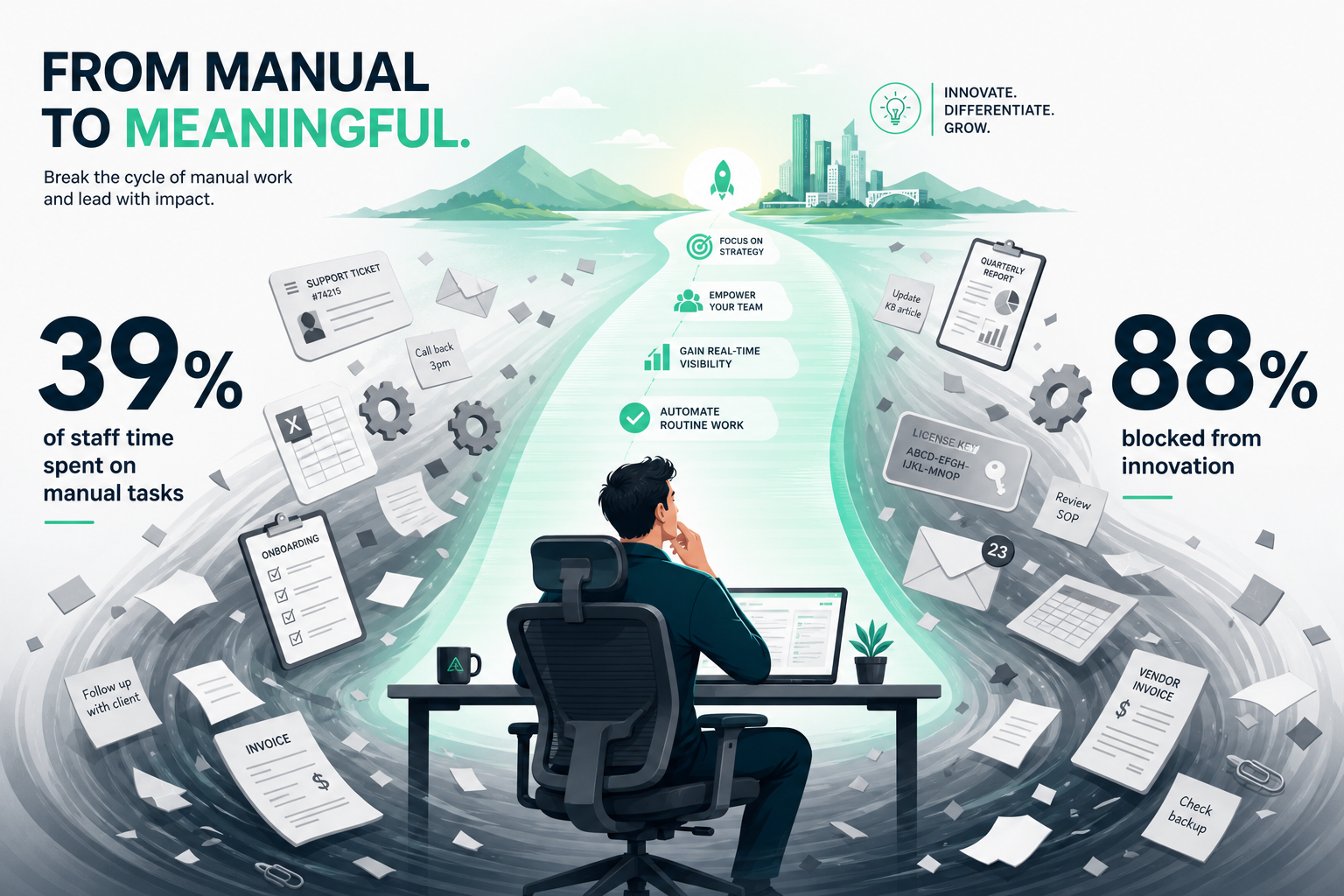
According to Forbes, MSP leaders estimate that 39% of staff time is spent on manual tasks, and 88% say these tasks prevent them from focusing on innovation or strategic goals. (Forbes)
That number should make every MSP pause.
Because the real issue is not simply “manual work is annoying.” The real issue is that manual work limits growth.
It slows down sales. It delays delivery. It increases the risk of errors. It creates friction for customers. And perhaps most importantly, it takes people away from the work where they create the most value: advising, building trust, solving problems, and developing customer relationships.
Automation should not replace human relationships. It should protect them.
There is a common misunderstanding around automation in the MSP industry.
Some people hear “automation” and think it means removing people from the customer journey. But for MSPs, the opposite should be true.
The goal of automation is not to make the business less human. The goal is to remove the repetitive, low-value work that prevents people from being human where it matters most.
Customers do not choose an MSP only because of a product catalogue. They choose an MSP because they trust the people behind it. They want advice. They want guidance. They want someone who understands their business, their risks, and their ambitions.
That is why automation and human relationships must work together.
Automate the tasks machines can do:
- syncing customers
- importing product data
- updating pricing
- Price comparison
- connecting billing terms
- submitting subscription orders
- routing information between systems
- keeping catalogues structured and updated
Then give people more time for the work only humans can do:
- advising customers
- identifying new opportunities
- building stronger relationships
- packaging services around real customer needs
- creating better buying experiences
- helping customers make smarter IT decisions
This balance is becoming even more important. Gartner predicts that by 2030, 75% of B2B buyers will prefer sales experiences that prioritise human interaction over AI. (Gartner)
That does not mean buyers want slow, manual processes. It means they want efficient digital experiences combined with real human expertise.
For MSPs, that is the sweet spot.
How do distributor integrations improve MSP efficiency?
Distributor integrations improve efficiency by reducing the number of manual steps between product sourcing, service creation, sales, ordering, and delivery.
Without integration, the process may look like this:
A team member logs into a distributor portal, searches for products, checks pricing, copies product details, updates an internal catalogue, confirms billing terms, creates or matches a customer, submits an order, and then updates another system to keep the team informed.
With integration, many of these steps can be automated or handled inside one platform.
This helps MSPs:
- reduce time spent in distributor portals
- avoid double entry
- lower the risk of manual errors
- keep product information more consistent
- make products available for sale faster
- speed up subscription ordering
- improve internal visibility
- create a smoother customer experience
The impact is not only operational. It can also improve profitability.
When teams spend less time on manual work, the cost to serve each customer can decrease. When products and services can be launched faster, revenue opportunities can be captured sooner. When customers experience fewer delays, satisfaction can improve.
How distributor catalogues become customer-ready services
For modern MSPs, the real value is not simply having access to products. Many competitors have access to the same products.
The value comes from how those products are packaged, sold, delivered, and supported.
A distributor catalogue contains products. An MSP service catalogue turns those products into customer-ready offerings.
That difference matters.
A product may become part of a managed backup service, a security package, a cloud productivity bundle, or a subscription-based offering with support and delivery included.
But building those services manually takes time.
Distributor integrations can make it easier to bring products into a structured service catalogue, combine them with the MSP’s own services, and make them available through the right sales channels.
This allows MSPs to:
- launch new services faster
- create more consistent offerings
- improve product and service structure
- make it easier for customers to buy
- support recurring revenue models
- scale sales without scaling administration at the same pace
This is where integration becomes more than efficiency. It becomes a foundation for growth.
What is the ROI of distributor integrations for MSPs?
The ROI of distributor integrations usually appears in four areas.
1. Time saved
If a team spends hours every week logging into portals, checking product data, updating pricing, creating customers, and submitting orders, even partial automation can free up significant capacity.
For example, if a team spends 10 hours per week on distributor-related manual tasks, that equals more than 500 hours per year. If automation reduces that by 50%, the business gets back roughly 250hours annually.
That time can be used for customer meetings, service development, sales follow-up, onboarding, or support improvement.
2 . Fewer errors
Manual copying creates risk.
Wrong pricing. Incorrect billing terms.Duplicate customer records. Missing order details. Outdated catalogue information.
Each error has a cost, whether it appears as internal rework, customer frustration, delayed delivery, or lost trust.
Integrations reduce the number of places where humans need to re-enter the same information.
3. Faster sales and delivery
When product data, pricing, customers, and orders are connected, the path from opportunity to delivery becomes shorter.
MSPs can build services faster, respond to customer needs faster, and reduce delays between sale and fulfilment.
4. Better use of people
The biggest ROI may not be the time saved alone . It is what people do with that time.
A skilled employee should not spend the best hours of the week copying data between systems. They should be helping customers make better decisions, identifying upsell opportunities, improving service quality, and building long-term relationships.
Automation creates capacity for higher-value work.
How ZaveIT helps MSPs connect distributor data, services, sales, and delivery
ZaveIT is built for MSPs and IT resellers that want to bring sales, services, customers, orders, and delivery into one more connected workflow.
Distributor integrations are a key part of that vision.
With ZaveIT, MSPs can connect distributor data to the processes that drive their business. Instead of working across disconnected portals and internal systems, teams can use ZaveIT to bring products into a structured service catalogue, connect them to customer-facing sales channels, and support a smoother path from product import to order and delivery.
With integrations such as TD SYNNEXStreamOne Ion, users can sync customers, import product catalogues with pricing and billing terms, and submit subscription orders directly from ZaveIT.
But the larger point is not one distributor.
The larger point is that MSPs need a platform layer that connects distributors, services, sales, customer portals, and delivery management.
That is where ZaveIT creates value.
It helps MSPs move from manual, fragmented workflows to a more scalable operating model.
Why distributor integrations are becoming a competitive advantage
MSPs are expected to do more than resell technology. They are expected to advise, package, deliver, support, and continuously improve services for their customers.
That requires time, structure, and efficiency.
Distributor integrations help remove friction from the operational side of the business so teams can focus more on the customer side.
This creates a competitive advantage because MSPs can:
- respond faster to customer needs
- build and launch services faster
- reduce administrative workload
- improve accuracy
- deliver a better digital buying experience
- give employees more time for advisory work
- grow without adding unnecessary complexity
The MSPs that win in the future will not necessarily be the ones with access to the most products.
They will be the ones that can turn products into valuable, scalable services — faster, more efficiently, and with a better customer experience.
Watch the demo- How to Set Up the TD SYNNEX ION integration in ZaveIT
Let machines do the machine work
Distributor integrations matter because they help MSPs work the way modern businesses need to work.
They reduce manual tasks. They connect systems. They improve accuracy. They speed up service creation. And they give people more time to focus on customers.
Automation should not make the MSP less human.
It should make space for more human work.
Let machines handle the repetitive tasks: syncing data, importing products, updating information, and submitting structured orders.
Let people focus on relationships, advice, trust, and growth.
That is where modern MSPs can create real differentiation.
And that is why distributor integrations are becoming an essential part of the MSP operating model.
See all integrations in ZaveIT and what´s coming soon