What Is MSP Service Productisation?
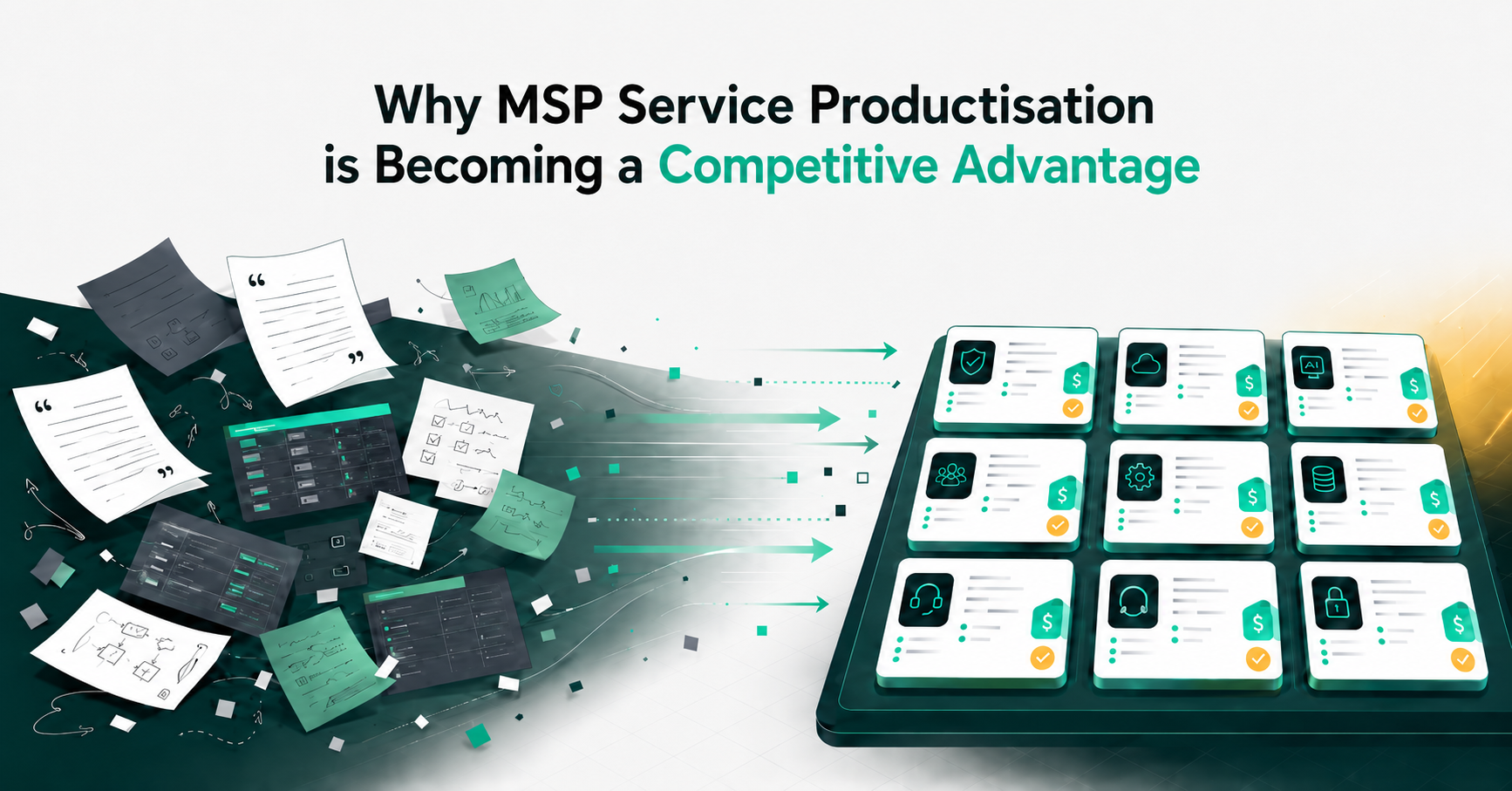
MSP service productisation is the practice of turning custom, project-based work into repeatable, catalog-listed services with fixed scope, fixed price, and predictable delivery. Think of it as taking a chef's daily specials and putting them on a printed menu. Same kitchen, same skills, but the ordering, pricing, and expectations become standardised for buyer and seller alike.
A productised service has four things a custom project doesn't: a name, a fixed price band, a documented delivery process, and a defined outcome the client can point to. Miss any of those, and it's still a project wearing a product costume.
The Data Behind the Shift: Why 2026 Is the Turning Point
Three data points, from three separate authoritative sources, tell the same story.
Kaseya's 2026 report shows the share of MSPs reporting typical customer spending above $25,000 per year fell to 41%, down from 75% the year before. That's not a soft trend. That's the average customer becoming nearly half as valuable in twelve months.
Datto's Global MSP Benchmark puts median MRR share at 62% across more than 1,900 respondents. The MSPs with recurring revenue above 60% are the ones commanding the higher valuation multiples in M&A. Each ten percentage point uplift historically correlates with 0.75x to 1.25x multiple expansion, a reward the market pays specifically for revenue that's productised enough to be predictable.
Service Leadership, the industry's longest-running benchmarking authority, has repeatedly shown that best-in-class MSPs run services gross margins of 48% or higher, while a meaningful portion of the market operates near break-even or worse. The delta between top-quartile and bottom-quartile MSPs is explained almost entirely by two things: standardisation and pricing discipline.
Both of those are what productisation actually is.
Here's the honest bit. If you've been running your MSP off custom scopes of work and hero-technician heroics, none of this feels surprising. It feels like the industry is finally naming what you've been quietly worried about for eighteen months.

Why Custom-Everything Is Killing MSP Margins
The old MSP model was built on relationship and responsiveness. You knew every client. You'd bend the scope. You'd throw in an extra hour to keep the account warm. That model worked when deal sizes were fat and technicians were plentiful.
Neither is true now.
Kaseya's data shows the share of MSPs reporting difficulty hiring skilled technicians nearly doubled year over year, from 9% to 16%. Meanwhile average deal size shrinks. Every custom exception, every one-off pricing carve-out, every "we'll figure it out on delivery" moment now eats labour that's harder to hire and margin that's harder to earn.
I've watched MSP owners realise this on whiteboards. They map their last twenty deals and find that no two were priced the same way. Same technology, same client size, same outcome six different quotes, four different SOWs, and a services margin that ranges from 61% to negative-eight.
That's not a sales problem. That's a productisation problem.
Standardising the catalog fixes the leak. When services are named, priced, and scoped the same way every time, the entire quote-to-cash chain speeds up. Technicians stop guessing at scope. Finance stops chasing exceptions. Sales stop discounting. And the customer, honestly, stops trying to negotiate. Because there's nothing left to negotiate when the offer is a menu, not a manuscript.
The Four Traits Every Productised MSP Service Shares
Real productised services, the ones that actually move margins share a small, boring set of traits. Miss any one and you're back to custom work with a nicer name.
A fixed scope you can defend in a room. If a technician can't say in one sentence what's included and what isn't, the service isn't productised. Ambiguity is where the margin dies.
A price the buyer can validate without a sales call. Published tiers, transparent add-ons, no "contact us for pricing" hiding in the footer. AI-powered buying agents, doing pre-purchase research on behalf of IT teams, filter out anything they can't parse. So do the humans, quietly.
A delivery playbook the greenest technician can follow. If the service depends on a specific senior engineer, you don't have a product. You have a person with a job. Productised services encode expertise into checklists, templates, and automations.
An outcome the client can point at in a QBR. "Managed detection and response" is a category, not an outcome. "Contained incident response within 15 minutes, 24/7" is an outcome. Productised services promise something specific enough to survive contract renewal.
Four traits. Not five. Not a maturity model with seventeen sub-categories. When services meet all four, they compound. When they miss even one, the model quietly reverts to custom mode.
How Productisation Compounds Into a Real Moat
Here's the part most MSPs undersell to themselves.
A productised catalog isn't just a pricing move. It's the substrate that makes every other 2026 growth play possible.
Consider AI monetisation, the topic every MSP is chasing right now. Kaseya's report notes that 53% of MSPs already use AI internally for ticketing, patching, and monitoring. Yet only 13% earn meaningful revenue from AI. Why? You can't sell what you can't package. A productised service catalog is the container AI-included SKUs live inside. Without it, "AI" stays an internal efficiency win instead of a revenue line.
Consider co-managed IT, one of the fastest-growing service categories in the same report. Co-managed only works if the offer is legible to an internal IT team evaluating you against their own capacity. Custom SOWs don't sell co-managed. Catalog listings do.
Consider marketplace listings on Pax8, TD SYNNEX, or Ingram Micro Xvantage. Distributors want SKUs, not stories. If your services aren't productised, they can't be resold, bundled, or listed anywhere except your own quote.
Consider partner scaling. A reseller of yours can only sell what you've packaged. A partner in another region can only deliver what you've documented. Productisation isn't just a margin lever. It's the export format of your business.
That's the quiet joy of productisation. It doesn't fix one thing. It fixes the one thing that makes every other growth play work.
The KPIs That Prove Productisation Is Working
You'll know the strategy is landing when four numbers start moving in the right direction.
Services gross margin should climb toward the 48% Service Leadership benchmark. If it isn't, the catalog has too many exceptions or the pricing rules aren't being enforced.
MRR share of total revenue should push past 60%. Datto's data shows this threshold as the inflection point where valuation multiples expand. Below it, the business still trades like a project shop.
Quote-to-order conversion time should shorten by weeks, not days. When quotes generated directly from a fixed catalog rather than being handbuilt in Excel, the cycle collapses. This is the single most visible operational win and the one prospective customers feel first.
Managed-services attach rates on new deals should rise. Productised catalogs make cross-sell trivial. Add-ons get ticked, not negotiated.
None of these are vanity metrics. They're the four numbers that show up in every serious MSP financial review, and they're the four an acquirer will ask about the moment your business starts looking interesting.

Where MSPs Get Stuck
Most MSPs know all of this. It's not what's stopping them.
What's stopping them is the operational lift. The catalog needs to live somewhere. The pricing rules need a system to enforce them. Quotes need to auto-generate from the catalog rather than get retyped in Excel. Subscription billing needs to reconcile against consumption. The self-service portal needs to reflect the same catalog the sales team sees. And the whole thing has to sync with distributor feeds so vendor price changes don't quietly erode margin overnight.
Doing all of that inside a spreadsheet-plus-PSA-plus-QuickBooks stack is where productisation initiatives go to die. Not because MSP owners lack the discipline. Because the stack physically can't hold the model together.
This is where a commerce and service-automation platform stops being a nice-to-have and starts being the reason the strategy works. A unified catalog. A quoting engine that reads from it.
A customer self-service portal that exposes the same offers to buyers. A partner network layer that lets resellers operate on the same catalog through PSA-grade tooling. A billing engine that trues up against consumption. Same source of truth from the first quote to the sixtieth renewal.
Frankly, that's not a software preference. It's the operational floor productisation stands on.
If you're serious about turning services into products in 2026, the tooling question stops being "should we buy something?" and becomes "how quickly can we move to a system that lets the strategy actually run?"
The Competitive Advantage Isn't AI. It's the Wrapper Around AI
Every MSP I speak with in 2026 wants to talk about AI. The successful ones want to talk about how they're packaging it.
Productisation is that packaging. It's the reason two MSPs with identical technology have wildly different margins. It's why Service Leadership's top quartile clears 48% gross margin while the bottom quartile hovers near zero. It's why Datto's benchmarks link MRR discipline to 0.75x-1.25x M&A multiple expansion. It's why cloud adoption has already happened but profitability hasn't the shift was technical, the missing move is commercial.
None of that is about buying better tools. It's about turning what you already deliver into something that scales without you in the room.
The MSPs that get this right in 2026 won't just grow faster. They'll be the ones acquiring the ones that don't.
If you want to see what a productised commerce and service catalog looks like end-to-end from distributor feed to recurring invoice, running on one platform talk to the ZaveIT team. It's the fastest way to know whether your current stack can carry a productisation strategy, or whether it's the reason your last one stalled.